How to know when a Spanish word needs an accent mark
Most Spanish words don't have an accent mark. You write one in four cases: when the stress falls in an unusual place (café), when a stressed i or u sits next to a, e or o (día), on a few short words that have a twin (tú and tu), and on question words (¿qué?, ¿dónde?).
The mark always goes on a vowel: á, é, í, ó, ú. It shows which part of the word you say louder. It never changes the sound of the vowel itself.
Two more marks look similar but do other jobs. The dots in ü (pingüino, vergüenza) tell you to say the u. The ñ isn't an accented n. It's a separate letter of the alphabet. To type any of these, use the Spanish accent keyboard.
One word, three meanings
Before the rules, here's why accents matter. These three words have the same letters:
práctico
practicalpractico
I practicepracticó
he practiced, she practiced
The accent tells you where to put the stress, and the stress changes the word. Many pairs work like this:
| Without accent | With accent |
|---|---|
| hablo I speak |
habló he spoke, she spoke |
| termino I finish |
terminó he finished, she finished |
| esta casa this house |
está aquí it's here |
| el papa the Pope |
el papá the dad |
So a missing accent isn't just a spelling slip. Sometimes it turns “he spoke” into “I speak.” You'll see a lot of these past forms in the Spanish preterite rules.
Case 1: the stress is in an unusual place
Every word has one part (syllable) you say louder. Spanish has a normal place for it, and it depends on the last letter of the word:
| Word ends in | Normal stress no accent |
Different stress accent needed |
|---|---|---|
| a vowel, n or s | CA-sa, HA-blan, LI-bros house, they speak, books |
café, canción, inglés coffee, song, English |
| any other letter | ha-BLAR, ciu-DAD, es-pa-ÑOL to speak, city, Spanish |
árbol, fácil, móvil tree, easy, mobile phone |
If a word follows the normal pattern, it doesn't need a mark. If you say it a different way, the accent shows you where the stress goes.
Look at joven (young). You say JO-ven. It ends in n, so the stress on the second-to-last part is normal. No accent.
Now look at también (also). You say tam-BIÉN. It ends in n, but the stress is on the last part. That's unusual, so it gets an accent.
Stress three from the end: always an accent
Some words are stressed even earlier, three parts from the end. These always have an accent:
música, teléfono, sábado, miércoles
music, telephone, Saturday, Wednesday
Case 2: a stressed i or u next to a, e or o
Usually i and u blend with the vowel next to them. The ie in bien (well) and the ua in agua (water) each sound like one beat. No accent.
When you say the i or u louder than the a, e or o next to it, the two vowels split apart. Then the i or u always gets an accent, even if the normal rules say no:
día, tío, país
day, uncle, countryMi tía comía con nosotros todos los días.
My aunt used to eat with us every day.
This explains a lot of past forms. Comía, vivía and había all need the accent, because you say co-MÍ-a. You'll meet them all in our post on the Spanish imperfect.
Iba (I was going, he was going) doesn't. You say I-ba, the stress falls on the second-to-last part, and the word ends in a vowel. That's the normal pattern.
Case 3: short words with a twin
Most one-part words never take an accent. These have no mark:
fui, fue, vi, vio, dio, ti
I went, he went, I saw, he saw, he gave, you (as in para ti, “for you”)
A few short words come in pairs that sound the same. The accent tells them apart:
| With accent | Without accent |
|---|---|
| tú tienes razón you're right |
tu móvil your phone |
| él es mi hermano he's my brother |
el coche the car |
| es para mí it's for me |
mi casa my house |
| sí, vale yes, OK |
si llueve if it rains |
| no sé I don't know |
se llama Ana her name is Ana |
| un té con leche tea with milk |
te quiero I love you |
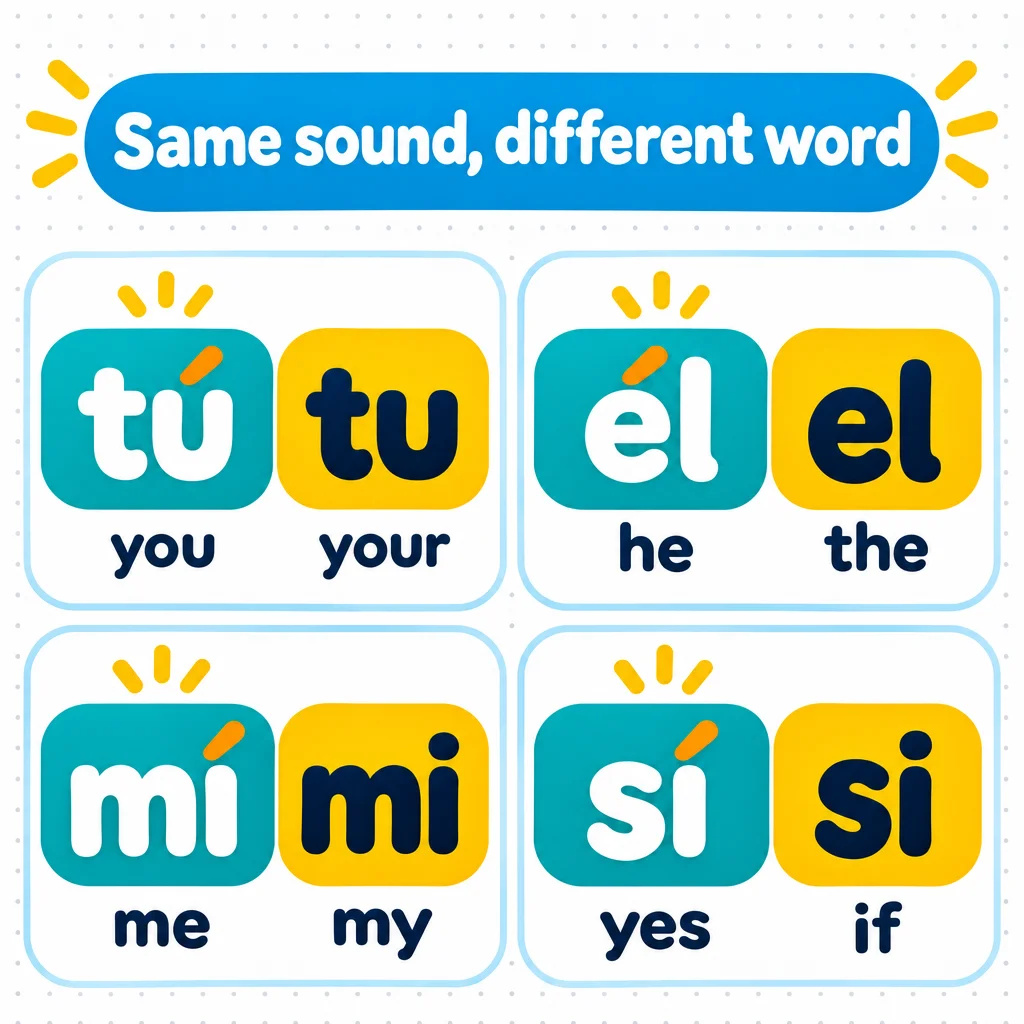
Más (more) also has an accent: Quiero más. (I want more.)
Notice that ti has no twin, so it has no accent. Para ti is right. Para tí is a very common mistake.
In older books you may also see sólo (only) and éste (this one) with an accent. Today the usual spelling is solo and este, without one.
Case 4: question words
Question words always have an accent when they ask something. Without the accent, they're ordinary linking words:
| Asking | Linking |
|---|---|
| ¿Qué quieres? What do you want? |
Creo que sí. I think so. |
| ¿Cómo te llamas? What's your name? |
Como no tengo coche, voy en metro. Since I don't have a car, I take the metro. |
| ¿Dónde vivís? Where do you all live? |
La casa donde vivo es pequeña. The house where I live is small. |
| ¿Cuándo llegas? When are you arriving? |
Ceno cuando llego a casa. I have dinner when I get home. |
The same goes for quién, cuál and cuánto.
Keep the accent when the question is hidden inside a sentence, and in exclamations:
No sé dónde está mi móvil.
I don't know where my phone is.¡Qué frío hace!
It's so cold!
For more on asking questions, read our post on qué, cuál and cómo.
All four cases in one chart
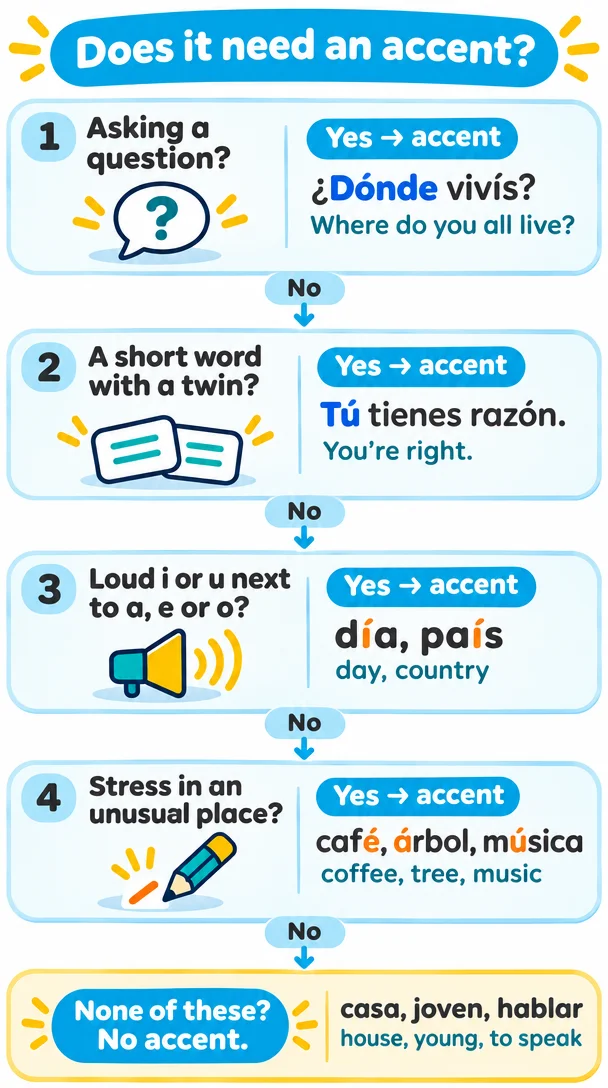
When you're not sure about a word, go through these four questions in order:
Accents that come and go
When a word grows longer, the stress usually stays on the same part, but the rules may change. So an accent can appear or disappear:
| Short form | Longer form |
|---|---|
| canción song |
canciones songs |
| inglés English, Englishman |
ingleses English people |
| joven young |
jóvenes young people |
| examen exam |
exámenes exams |
| compra el pan buy the bread |
cómpralo buy it |
| dime tell me |
dímelo tell it to me |
In cómpralo and dímelo, the extra word at the end pushes the stress three parts from the end. That's why the accent appears. You'll see this often with commands.
Capital letters keep their accents
Capital letters follow the same rules. Don't drop the accent just because the letter is big:
Él vive en Ávila.
He lives in Ávila.
Mistakes English speakers make
| Wrong | Right | Why |
|---|---|---|
| Ayer |
Ayer fue al cine. He went to the movies yesterday. |
Short words like fue and fui have no accent. |
| Es para |
Es para ti. It's for you. |
Ti has no twin, so no accent. |
| Tú eres mi amigo. You're my friend. |
Tú means “you.” Tu means “your.” | |
| No sé |
No sé dónde vive. I don't know where he lives. |
It's a hidden question. |
| Tengo un |
Tengo un examen. I have an exam. |
Ends in n, stressed on the second-to-last part. |
| Tengo dos |
Tengo dos exámenes. I have two exams. |
Now the stress is three from the end. |
| Mis vecinos son |
Mis vecinos son ingleses. My neighbors are English. |
The plural follows the normal pattern. |
Practice 1: add the accents to Lucía's message
Lucía from Madrid sends Tom a message, but her phone removed all the accents. Add the 15 missing accents. Some words that look like they need one don't.
Hola, Tom. ¿Que tal? Mañana voy a la cafeteria con mi hermana. ¿Vienes tu tambien? Si, ya se que tienes examen el miercoles, pero es un cafe rapido. Mi hermana estudia ingles. Habla muy rapido, pero es muy simpatica. ¿Donde vivis ahora, tu y Marta?
Answer
Hola, Tom. ¿Qué tal? Mañana voy a la cafetería con mi hermana. ¿Vienes tú también? Sí, ya sé que tienes examen el miércoles, pero es un café rápido. Mi hermana estudia inglés. Habla muy rápido, pero es muy simpática. ¿Dónde vivís ahora, tú y Marta?
Here's why each one needs it:
- Qué, Dónde: question words.
- tú, Sí, sé: short words with a twin. Each tú means “you.”
- cafetería: a stressed í next to a vowel.
- también, café, inglés, vivís: stressed on the last part, ending in a vowel, n or s.
- miércoles, rápido, simpática: stressed three from the end.
These stay as they are: mi hermana (my sister), que tienes (that you have), examen and Mañana. The ñ isn't an accent.
Practice 2: choose the right word
- ¿(Tu / Tú) tienes mi móvil?
- Es (tu / tú) ordenador.
- No (se / sé) a qué hora empieza.
- (Si / Sí) quieres, vamos al cine.
- ¿Quieres un (te / té)?
- Ayer Ana (hablo / habló) con su jefe.
- Este regalo es para (mi / mí).
- ¿(Donde / Dónde) está la estación?
Show answersHide answers
- Tú: it means “you.”
- tu: it means “your.”
- sé: it means “I know.”
- Si: it means “if.”
- té: it means “tea.”
- habló: Ana spoke, in the past. Hablo would mean “I speak.”
- mí: it means “me.”
- Dónde: it's a question.
Quick questions
Do Spanish speakers always write accents? In fast chats, some people skip them. In emails, school work and exams, a missing accent counts as a spelling mistake.
Does the accent change how the vowel sounds? No. é sounds like e. The accent only shows which part of the word is louder.
Where to practice
Question words come up in every conversation. Try the question exercises on Espanido. For past forms like habló and comió, practice with the preterite exercises.
To see where tú and él fit, read our guide on when to say yo, tú or usted.

