Spanish questions with qué, cuál and cómo
You want to ask a simple question in Spanish, but three small words get in the way: qué, cuál and cómo. They can all translate differently depending on the sentence, so the best way to learn them is through common question patterns rather than one-word translations.
Want to practice right away? Start the preguntas exercise.
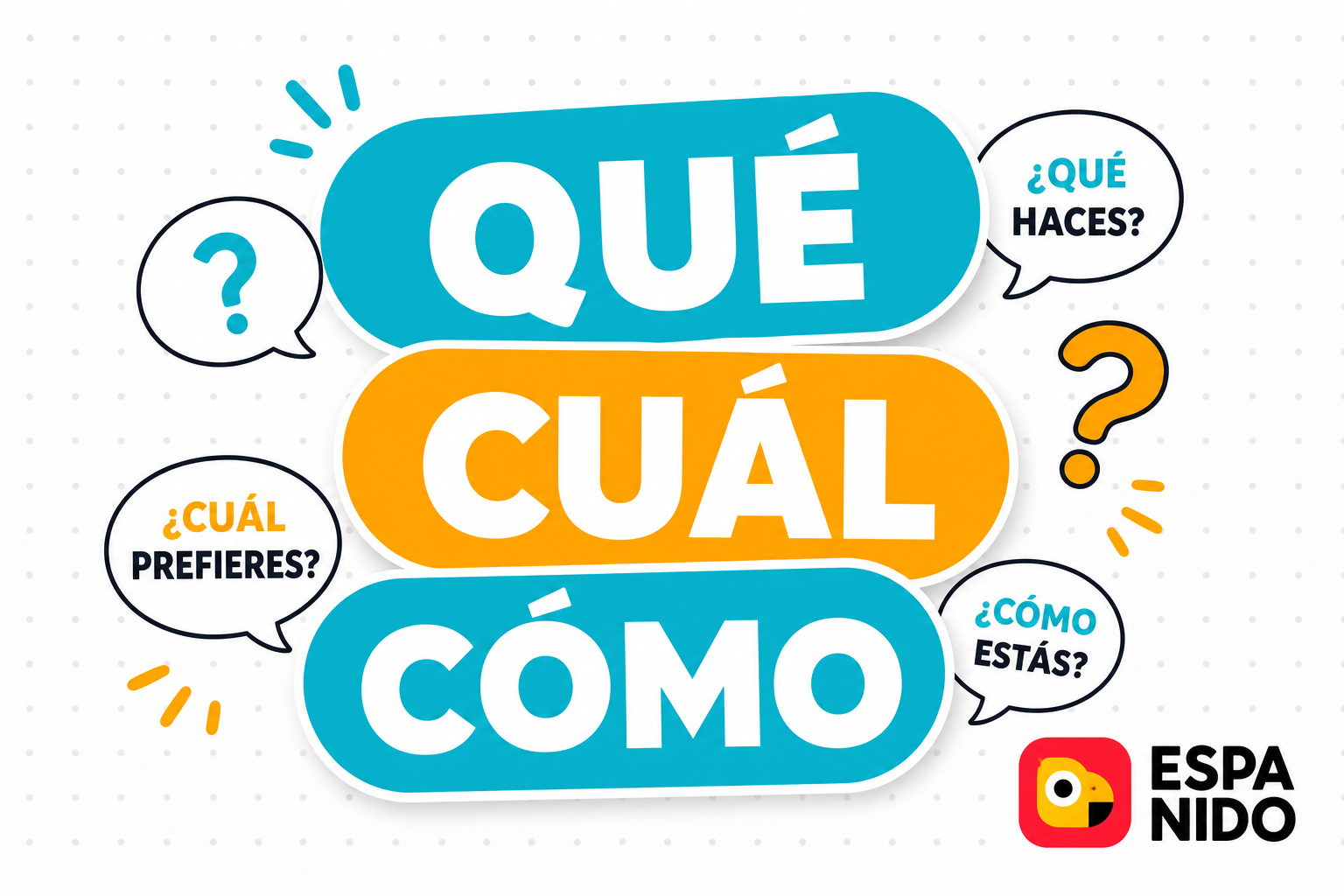
In this guide, you will learn the difference between qué and cuál in Spanish, when to use cómo, and how to avoid the mistakes English speakers often make. You will also find quick tables, real-life examples and links to Spanish question practice on Espanido.
The quick answer
Use qué to ask what something is, what something means or what kind of thing someone wants. It also comes directly before a noun.
- ¿Qué significa esta palabra? — What does this word mean?
- ¿Qué libro estás leyendo? — What book are you reading?
- ¿Qué quieres hacer? — What do you want to do?
Use cuál to ask which one or which ones. It often asks someone to identify an item, person or answer from a known or possible group.
- ¿Cuál prefieres? — Which one do you prefer?
- ¿Cuál es tu dirección? — What is your address?
- ¿Cuáles son tus zapatos? — Which ones are your shoes?
Use cómo to ask how something happens, how someone feels or what something is like.
- ¿Cómo estás? — How are you?
- ¿Cómo funciona? — How does it work?
- ¿Cómo es tu profesor? — What is your teacher like?
Here is the basic comparison:
| Question word | Main idea | Common pattern |
|---|---|---|
| qué | what, what kind of | qué + noun or qué + verb |
| cuál / cuáles | which one or which ones | cuál + verb |
| cómo | how or what…like | cómo + verb |
These are helpful starting points, not mechanical translation rules. The sentence around the question word matters.
When to use qué
Use qué before a noun
When the question word comes directly before a noun, Spanish normally uses qué, not cuál.
- ¿Qué película quieres ver? — Which movie do you want to watch?
- ¿Qué camisa vas a comprar? — Which shirt are you going to buy?
- ¿Qué tren va al centro? — Which train goes downtown?
- ¿Qué idiomas hablas? — What languages do you speak?
Notice that English may use either what or which. Spanish still uses qué because the noun follows it directly: qué película, qué camisa and qué tren.
A common English-speaking learner mistake is:
- Incorrect: ¿Cuál película quieres ver?
- Standard Spanish: ¿Qué película quieres ver? — Which movie do you want to watch?
You may hear cuál + noun in some regions, especially in parts of Latin America. However, qué + noun is the safest pattern to use in standard Spanish.
Use qué to ask for an explanation or definition
Use qué when you want to know what something is, what it means or what someone is doing.
- ¿Qué es una tapa? — What is a tapa?
- ¿Qué significa barato? — What does barato mean?
- ¿Qué haces? — What are you doing?
- ¿Qué pasó ayer? — What happened yesterday?
Imagine that you see the word sobremesa for the first time. You are not choosing it from a list. You want its meaning, so you ask ¿Qué significa sobremesa?
Use qué in common preposition patterns
A preposition is a small word such as de, con or para. Spanish often places one before qué.
- ¿De qué hablas? — What are you talking about?
- ¿Con qué escribes? — What are you writing with?
- ¿Para qué sirve esto? — What is this used for?
- ¿En qué piensas? — What are you thinking about?
Do not leave the preposition at the end as you often can in English. Spanish says ¿De qué hablas?, literally, About what are you talking?
When to use cuál
Use cuál to identify one option
Use cuál when the answer identifies one item, fact or option. The possible answers may be visible, already mentioned or simply understood from the situation.
- Tengo dos chaquetas. ¿Cuál prefieres? — I have two jackets. Which one do you prefer?
- ¿Cuál quieres, el rojo o el azul? — Which one do you want, the red one or the blue one?
- ¿Cuál es la respuesta correcta? — Which is the correct answer?
The group does not always need to be small or clearly listed. For example, ¿Cuál es tu número de teléfono? asks the listener to identify their phone number, even though no list appears in the conversation.
Use cuál with ser for personal information
Many questions about personal details follow cuál + ser. Although English uses what, Spanish often treats the answer as a specific identifying fact.
- ¿Cuál es tu nombre? — What is your name?
- ¿Cuál es tu dirección? — What is your address?
- ¿Cuál es tu correo electrónico? — What is your email address?
- ¿Cuál es tu comida favorita? — What is your favorite food?
This does not mean that cuál must always appear before ser. Compare these two questions:
- ¿Qué es una paella? — What is paella?
- ¿Cuál es tu paella favorita? — Which is your favorite paella?
The first asks for a definition or explanation. The second asks you to identify a favorite.
Use cuáles for plural answers
Cuál changes to cuáles when you expect more than one answer or ask which ones.
- ¿Cuáles son tus libros? — Which ones are your books?
- ¿Cuáles prefieres? — Which ones do you prefer?
- ¿Cuáles son tus planes para el fin de semana? — What are your plans for the weekend?
There is no masculine or feminine form. Use cuál for one answer and cuáles for more than one.
Qué vs cuál in Spanish
The difference between qué and cuál in Spanish becomes clearer when you compare similar questions.
| Spanish question | Meaning | Why? |
|---|---|---|
| ¿Qué es eso? | What is that? | You want an explanation or definition. |
| ¿Cuál es el tuyo? | Which one is yours? | You want one item to be identified. |
| ¿Qué bebida quieres? | Which drink do you want? | Qué comes directly before a noun. |
| ¿Cuál quieres? | Which one do you want? | The noun is understood and not repeated. |
| ¿Qué estudias? | What do you study? | You ask for general information. |
| ¿Cuál es tu asignatura favorita? | What is your favorite subject? | You ask for a specific identifying answer. |
A useful shortcut is:
- If a noun comes immediately after the question word, choose qué.
- If the question means which one and the noun is understood, choose cuál.
- If you want a definition, choose qué.
Now look at a short café conversation:
- ¿Qué bebida quieres? — Which drink do you want?
- No sé. ¿Cuál recomiendas? — I don’t know. Which one do you recommend?
- El chocolate caliente. — The hot chocolate.
The first question uses qué before bebida. The second uses cuál because bebida is already understood.
When to use cómo
Use cómo to ask how
The most direct meaning of cómo is how. Use it to ask about a method, process or condition.
- ¿Cómo llego a la estación? — How do I get to the station?
- ¿Cómo preparas esta sopa? — How do you make this soup?
- ¿Cómo aprendiste español? — How did you learn Spanish?
- ¿Cómo te sientes hoy? — How do you feel today?
If the expected answer explains a method, cómo is usually the right choice.
Use cómo to ask what someone or something is like
The pattern ¿Cómo es…? asks for a description. English often uses What is…like? instead of How is…?
- ¿Cómo es tu ciudad? — What is your city like?
- ¿Cómo es Ana? — What is Ana like?
- ¿Cómo era el hotel? — What was the hotel like?
An answer may describe appearance, personality or general qualities: Es tranquila y bonita — It is quiet and pretty.
Compare that with qué:
- ¿Qué es un hostal? — What is a hostel?
- ¿Cómo es el hostal? — What is the hostel like?
The first asks for a definition. The second asks for a description of a particular hostel.
Use cómo to ask someone to repeat something
If you did not hear or understand, you can say:
- ¿Cómo? — Sorry? / What?
- ¿Cómo dices? — What did you say?
- ¿Cómo se dice esto en español? — How do you say this in Spanish?
In a formal situation, ¿Cómo? is often softer than a direct ¿Qué? when asking someone to repeat themselves.
Remember the written accents
Question words carry written accents: qué, cuál, cuáles and cómo. They keep these accents in both direct and indirect questions.
Direct questions use question marks:
- ¿Qué quieres comer? — What do you want to eat?
- ¿Cuál prefieres? — Which one do you prefer?
Indirect questions sit inside a larger sentence:
- No sé qué quiere comer. — I don’t know what he or she wants to eat.
- Dime cuál prefieres. — Tell me which one you prefer.
- Quiero saber cómo funciona. — I want to know how it works.
Even without question marks, the words still introduce a question, so the accents remain.
Common mistakes to avoid
Translating every English what as qué
English what can become qué, cuál or even cómo.
- What is your address? → ¿Cuál es tu dirección?
- What is a tortilla española? → ¿Qué es una tortilla española?
- What is your new apartment like? → ¿Cómo es tu piso nuevo?
Instead of translating one word at a time, think about the answer you want: a definition, an identity or a description.
Using cuál directly before a noun
For broad, standard Spanish, use qué before a noun.
- Better: ¿Qué canción te gusta? — Which song do you like?
- Not the safest general pattern: ¿Cuál canción te gusta?
If you remove the noun, use cuál: ¿Cuál te gusta? — Which one do you like?
Forgetting the accents
Without accents, que, cual and como often connect parts of a statement rather than ask for information. Writing the accents makes your meaning clear.
- ¿Cómo lo haces? — How do you do it?
- Lo hago como tú. — I do it like you.
A simple three-step choice
When you are unsure, ask yourself these questions:
- Is a noun directly after the question word? Use qué: ¿Qué restaurante prefieres?
- Am I asking which one or for a specific identifying fact? Use cuál: ¿Cuál prefieres?
- Am I asking about a method, condition or description? Use cómo: ¿Cómo es el restaurante?
These steps will not cover every regional expression, but they work well in most everyday conversations.
Practice qué, cuál and cómo
Complete these questions before checking the answers:
- ¿___ libro quieres comprar?
- ¿___ es tu número de teléfono?
- ¿___ se prepara el gazpacho?
- ¿___ significa esta frase?
- Hay tres rutas. ¿___ es más rápida?
- ¿___ es tu barrio?
Answers:
- Qué — A noun follows directly.
- Cuál — The question asks for a specific identifying fact.
- Cómo — The question asks about a method.
- Qué — The question asks for a meaning.
- Cuál — You are identifying one route from a group.
- Cómo — The question asks what the neighborhood is like.
Knowing the rule is a good start, but quick repetition helps you use it without stopping to translate. Review the Espanido guide to forming Spanish questions, then try the interactive Spanish question exercises for immediate practice.
Frequently asked questions
Can qué and cuál both mean what?
Yes. English often translates both words as what. Spanish uses qué for definitions and before nouns, while cuál commonly asks for one identified answer or fact.
Is cuál always used for a limited choice?
No. A visible list can make cuál easy to recognize, but a fixed list is not required. Questions such as ¿Cuál es tu opinión? and ¿Cuál es tu nombre? also ask for a specific answer.
Can I say cuál before a noun?
You may hear this pattern in some Spanish-speaking regions. For neutral, widely accepted Spanish, use qué directly before a noun: ¿Qué opción prefieres?
What is the difference between qué es and cómo es?
¿Qué es…? asks what something is or requests a definition. ¿Cómo es…? asks for a description of its qualities, appearance or personality.
Do indirect questions need accents?
Yes. Write qué, cuál and cómo with accents when they introduce an indirect question: No sé cuál elegir — I don’t know which one to choose.
The key idea to remember
Do not match qué, cuál and cómo to one English word each. Focus on the kind of answer you need: use qué for definitions and before nouns, cuál to identify an answer, and cómo for methods or descriptions.
With a little practice, these choices begin to feel natural. Start with the three-step check, notice the patterns in real conversations, and return to the Espanido exercises whenever you want a quick refresher.