How to choose preterite or imperfect in Spanish
Choosing between the preterite and imperfect can feel like guessing at first. The key is not simply when something happened, but how you want the listener to see the past event: as a completed action or as part of an ongoing scene.
Want to practice right away? Start the preterito indefinido exercise.
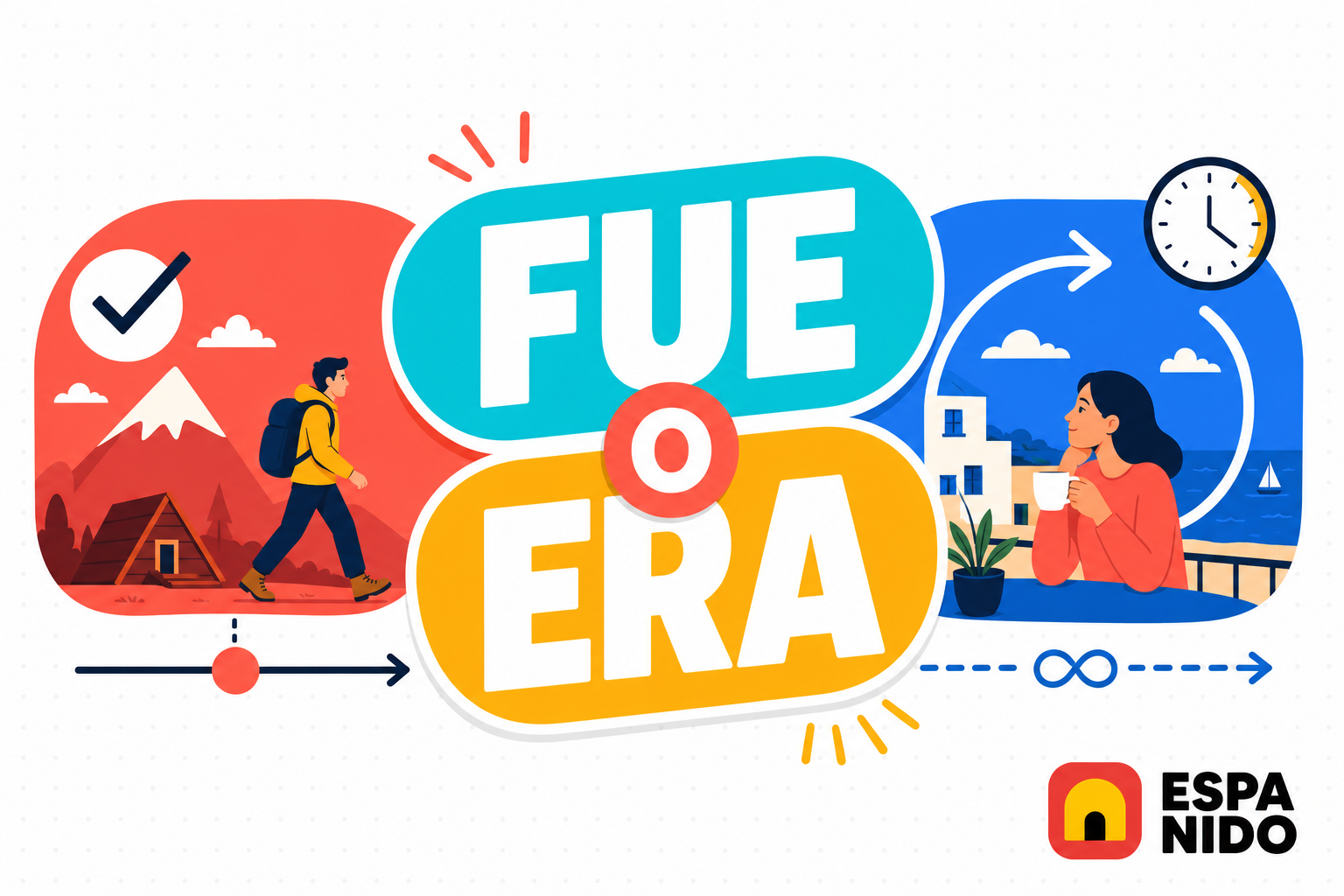
Both tenses talk about the past, and they often appear together. Once you learn the main contrast, you can stop memorizing long lists and start making choices based on the story you want to tell.
The short answer
Use the preterite for a completed past action that moves a story forward. Use the imperfect for background details, repeated habits, descriptions, and actions that were in progress.
Compare these examples:
- Ayer compré un libro. — “Yesterday I bought a book.”
- Cuando era niño, compraba muchos libros. — “When I was a child, I used to buy many books.”
In the first sentence, buying the book is one finished event. In the second, buying books was a repeated habit during an open period of childhood.
Here is the basic contrast:
| Choose the preterite for... | Choose the imperfect for... |
|---|---|
| A finished action | An action in progress |
| A specific event | A repeated past habit |
| The start or end of an action | Background information |
| A sequence of events | Descriptions, age, time, and weather |
| An interruption | The action being interrupted |
The preterite is also called the pretérito indefinido or pretérito perfecto simple. These names refer to the same tense in this article.
Think of a story, not a calendar
English speakers often look for time words such as “yesterday” or “last year.” Those words can help, but they do not choose the tense by themselves.
Instead, imagine that you are directing a film. The imperfect sets the scene, while the preterite shows the main events.
- Hacía frío y llovía. — “It was cold, and it was raining.”
- De repente, llegó Ana. — “Suddenly, Ana arrived.”
The cold and rain form the background. Ana’s arrival is the new, completed event that moves the story forward.
A useful question is: Am I showing the scene, or am I saying what happened next? For a scene, the imperfect is often right. For the next event, the preterite is often right.
When to use the preterite in Spanish
The Spanish preterite tense presents an action as complete. The action can be short or long; what matters is that you place boundaries around it.
One completed event
Use the preterite when an action happened and finished.
- Perdí mis llaves. — “I lost my keys.”
- Marta llamó a su madre. — “Marta called her mother.”
- Visitamos Sevilla el verano pasado. — “We visited Seville last summer.”
Each sentence reports a complete event. The speaker is not showing the action as unfinished or ongoing.
A clear number of times
Use the preterite when you say how many times something happened.
- Leí el mensaje tres veces. — “I read the message three times.”
- Fuimos a Madrid dos veces. — “We went to Madrid twice.”
- Te llamé una vez. — “I called you once.”
The number gives the action a clear limit.
A sequence of finished actions
The preterite is common when telling what happened step by step.
- Me levanté, preparé café y salí de casa. — “I got up, made coffee, and left the house.”
These actions create the main path of the story. One event follows another.
The beginning or end of something
Starting and finishing are natural boundaries, so verbs such as empezar, comenzar, terminar and acabar often appear in the preterite.
- La película empezó a las ocho. — “The movie started at eight.”
- La clase terminó temprano. — “The class ended early.”
To review the forms and try focused questions, see Espanido’s Spanish preterite guide and practice the preterite.
Spanish preterite conjugation at a glance
Regular preterite endings follow two main patterns. Verbs ending in -er and -ir share the same endings.
| Person | hablar | comer | vivir |
|---|---|---|---|
| yo | hablé | comí | viví |
| tú | hablaste | comiste | viviste |
| él, ella, usted | habló | comió | vivió |
| nosotros/as | hablamos | comimos | vivimos |
| vosotros/as | hablasteis | comisteis | vivisteis |
| ellos, ellas, ustedes | hablaron | comieron | vivieron |
Notice the written accents in forms such as hablé, habló, comí and comió. They are part of the correct spelling.
Some very common verbs are irregular. For example, fui can mean “I went” or “I was,” tuve means “I had,” and hice means “I did” or “I made.” Learn these forms through short sentences instead of trying to memorize every irregular verb at once.
When to use the imperfect
The imperfect does not focus on a clear beginning or end. It shows what used to happen, what was happening, or what a past situation was like.
Past habits and repeated actions
Use the imperfect for things that happened regularly.
- De niño, jugaba al fútbol cada sábado. — “As a child, I used to play soccer every Saturday.”
- Siempre cenábamos juntos. — “We always ate dinner together.”
- Mi abuela me llamaba los domingos. — “My grandmother used to call me on Sundays.”
English often uses “used to” or “would” for this meaning.
Actions in progress
Use the imperfect when you enter the middle of a past action without focusing on its end.
- Yo estudiaba en la biblioteca. — “I was studying in the library.”
- Los niños dormían. — “The children were sleeping.”
You are looking at the action while it is unfolding.
Descriptions and background details
The imperfect commonly describes people, places, feelings, time, age, and weather.
- La casa era pequeña y tenía un jardín. — “The house was small and had a garden.”
- Eran las nueve. — “It was nine o’clock.”
- Lucía tenía quince años. — “Lucía was fifteen years old.”
- Hacía mucho calor. — “It was very hot.”
These details create the setting instead of moving the story to its next event.
You can study the forms in Espanido’s imperfect guide and then practice the imperfect.
When both tenses appear together
Many natural Spanish sentences need both tenses. A common pattern is:
Imperfect action in progress + preterite interruption
- Caminaba al trabajo cuando empezó a llover. — “I was walking to work when it started to rain.”
- Dormíamos cuando sonó el teléfono. — “We were sleeping when the phone rang.”
- Ana cocinaba cuando llegó Luis. — “Ana was cooking when Luis arrived.”
The imperfect answers “What was going on?” The preterite answers “What happened?”
Now look at a short story:
Era viernes y hacía buen tiempo. Marta caminaba por el centro cuando vio una cartera en el suelo. La recogió, buscó una identificación y llamó a la dueña. Una hora después, las dos se encontraron en una cafetería.
“It was Friday, and the weather was nice. Marta was walking downtown when she saw a wallet on the ground. She picked it up, looked for identification, and called the owner. An hour later, the two met in a café.”
Era, hacía, and caminaba set the scene. Vio, recogió, buscó, llamó, and se encontraron tell the chain of completed events.
The same verb can change meaning
Sometimes the tense changes how a verb is understood. This is not a special rule to fear; it follows the same difference between an open situation and a completed event.
| Imperfect | Preterite |
|---|---|
| Sabía la respuesta. — “I knew the answer.” | Supe la respuesta ayer. — “I found out the answer yesterday.” |
| Conocía a Elena. — “I knew Elena.” | Conocí a Elena en 2022. — “I met Elena in 2022.” |
| Podía abrir la puerta. — “I was able to open the door.” | Pude abrir la puerta. — “I managed to open the door.” |
| Quería salir. — “I wanted to leave.” | Quise salir. — “I tried or decided to leave.” |
The imperfect describes an existing state. The preterite often points to a change, discovery, or completed attempt.
A quick decision guide
When you need to choose a tense, ask these questions in order:
- Is it a completed event or one step in a story? Use the preterite.
- Is it a habit that used to happen? Use the imperfect.
- Is it background information or a description? Use the imperfect.
- Was an action already in progress when another event happened? Use the imperfect for the ongoing action and the preterite for the interruption.
- Am I focusing on a beginning, end, or specific number of times? Use the preterite.
If both choices still seem possible, decide how you want to frame the action.
- Viví en México durante cinco años. — “I lived in Mexico for five years.”
- Vivía en México cuando conocí a Pablo. — “I was living in Mexico when I met Pablo.”
The first sentence presents the five-year period as complete. The second uses that period as background for meeting Pablo.
Common mistakes to avoid
Choosing only from signal words
Words such as ayer and de repente often appear with the preterite. Words such as siempre, a menudo, and de niño often appear with the imperfect.
These are useful clues, not automatic rules. Meaning and context matter more than one word.
Thinking long actions always need the imperfect
A long action can still be complete.
- Trabajé allí durante veinte años. — “I worked there for twenty years.”
Twenty years is long, but the speaker presents the period as finished. Duration alone does not decide the tense.
Using the preterite for every past action
A story made only of preterite forms may report events but give no setting. Add the imperfect to show what people were doing, how they felt, and what the place was like.
Translating English word by word
English simple past can match either Spanish tense. “I lived” could be viví if the period is complete or vivía if it is background information.
Choose the Spanish tense from the intended meaning, not only from the English verb form.
How to practice the choice
Start with pairs of sentences rather than isolated conjugations. Ask why one sentence shows a finished event and the other shows a habit or background scene.
Next, write a five-sentence story. Use two imperfect verbs to set the scene and three preterite verbs for the main events. For example, describe the weather and what you were doing, then add an unexpected phone call or visitor.
Finally, use instant feedback to notice patterns. Alternate between the preterite exercises and the imperfect exercises on Espanido. After each answer, say your reason aloud: “completed event,” “past habit,” “background,” or “action in progress.”
Frequently asked questions
Is the preterite only for short actions?
No. It can describe an action that lasted a minute or many years. Use it when you present the action as a complete period or event.
Is the imperfect always translated as “was doing”?
No. It can also mean “used to do,” and it is common for descriptions. Tenía diez años means “I was ten years old,” not “I was having ten years.”
Can one sentence contain both tenses?
Yes, and this is very common. The imperfect often gives the background or ongoing action, while the preterite introduces a completed event.
Are pretérito indefinido and preterite the same tense?
Yes. Spanish learning materials use several names, including pretérito indefinido and pretérito perfecto simple. In English, it is usually called the preterite.
What is the easiest rule to remember?
Think scene versus event. Use the imperfect to show the scene and the preterite to tell what happened within it.
The main idea to keep
Do not ask only, “Did this happen in the past?” Ask how the action fits into the story. A completed event usually takes the preterite, while a habit, description, or action in progress usually takes the imperfect.
You will not make every choice perfectly at first, and that is normal. With short stories and regular Espanido practice, the contrast will begin to feel natural.