How to use Spanish reflexive verbs correctly
Spanish reflexive verbs use a small pronoun such as me, te, or se. They follow a consistent pattern, and many describe familiar actions like getting up, washing, dressing, or going to bed.
Review the complete Spanish reflexive verbs lesson, or start the interactive exercise right away.
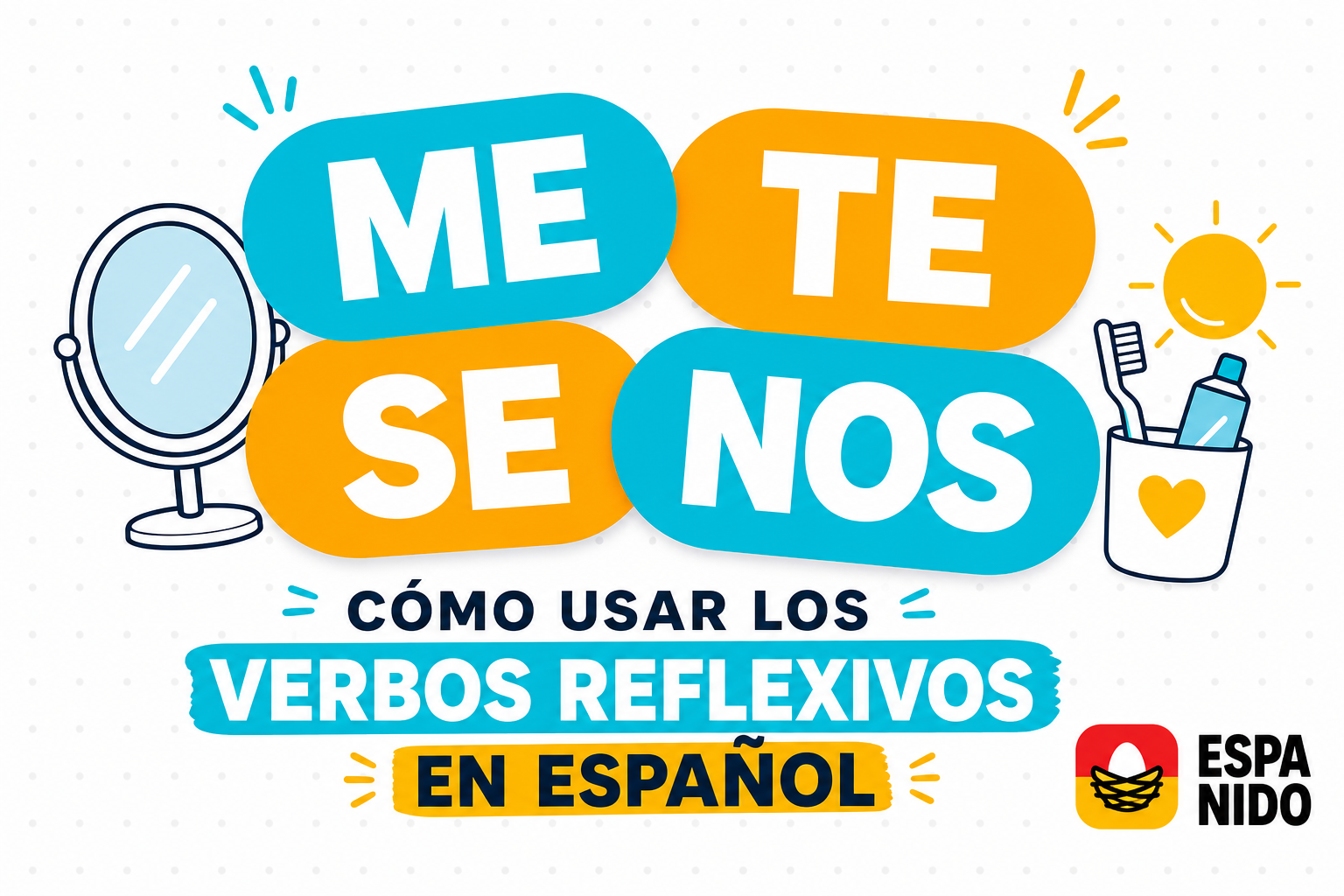
What is a reflexive verb in Spanish?
A reflexive verb shows that the person doing an action also receives the action. In simple terms, someone does something to themselves.
Compare these two sentences:
- Lavo el coche.: I wash the car.
- Me lavo.: I wash myself.
In the first sentence, I act on the car. In the second, the action comes back to me. The word me shows who receives it.
Spanish reflexive verbs appear in dictionaries with -se at the end:
- lavarse: to wash oneself
- vestirse: to get dressed
- sentarse: to sit down
- despertarse: to wake up
- acostarse: to go to bed
The -se changes when you use the verb in a sentence because it must match the person doing the action.
The Spanish reflexive pronouns
Every subject has a matching reflexive pronoun.
| Subject | Reflexive pronoun | Example |
|---|---|---|
| yo | me | Me levanto.: I get up. |
| tú | te | Te levantas.: You get up. |
| él, ella, usted | se | Ella se levanta.: She gets up. |
| nosotros/as | nos | Nos levantamos.: We get up. |
| vosotros/as | os | Os levantáis.: You all get up. |
| ellos, ellas, ustedes | se | Se levantan.: They get up. |
In most everyday sentences, the pronoun goes directly before a conjugated verb. A conjugated verb has been changed to match its subject, such as levanto for “I get up.”
How to conjugate a reflexive verb
Use this three-step method:
- Remove -se from the infinitive.
- Conjugate the remaining verb for the subject.
- Put the matching reflexive pronoun before the verb.
Take ducharse, meaning “to shower.” First, remove -se to get duchar. Then conjugate duchar and add the correct pronoun.
| Subject | Conjugation | Translation |
|---|---|---|
| yo | me ducho | I shower |
| tú | te duchas | you shower |
| él/ella/usted | se ducha | he, she, or you shower |
| nosotros/as | nos duchamos | we shower |
| vosotros/as | os ducháis | you all shower |
| ellos/ellas/ustedes | se duchan | they or you all shower |
Although the pronoun changes, the verb still follows its usual conjugation pattern. An irregular verb therefore remains irregular when it's reflexive.
For example, vestirse follows the same stem change as vestir:
- Me visto rápido.: I get dressed quickly.
- Te vistes antes del desayuno.: You get dressed before breakfast.
- Se viste de negro.: He or she dresses in black.
Common reflexive verbs for daily routines
Daily routines provide many examples of common reflexive verbs in Spanish.
| Spanish verb | Meaning | Example |
|---|---|---|
| despertarse | to wake up | Me despierto a las siete.: I wake up at seven. |
| levantarse | to get up | Nos levantamos temprano.: We get up early. |
| ducharse | to shower | Ana se ducha por la mañana.: Ana showers in the morning. |
| lavarse | to wash oneself | Te lavas las manos.: You wash your hands. |
| vestirse | to get dressed | Los niños se visten solos.: The children get dressed by themselves. |
| peinarse | to comb one’s hair | Me peino antes de salir.: I comb my hair before leaving. |
| acostarse | to go to bed | ¿A qué hora te acuestas?: What time do you go to bed? |
| dormirse | to fall asleep | Se duerme en el sofá.: He or she falls asleep on the sofa. |
Consider Marta’s morning: Marta se despierta, se levanta, se ducha y se viste. This means “Marta wakes up, gets up, showers, and gets dressed.” The same pronoun appears before each verb because Marta is doing each action to or for herself.
You can review more patterns in Espanido’s Spanish reflexive verbs lesson.
Where to put the reflexive pronoun
The pronoun usually comes before a conjugated verb:
- Me levanto a las ocho.: I get up at eight.
- Carlos se afeita cada mañana.: Carlos shaves every morning.
- Nos acostamos tarde.: We go to bed late.
Infinitives, gerunds, and commands follow different placement rules.
With an infinitive
When a conjugated verb is followed by an infinitive, you have two correct choices. The pronoun can go before the conjugated verb or attach to the infinitive.
- Me quiero acostar.: I want to go to bed.
- Quiero acostarme.: I want to go to bed.
Both sentences mean the same thing. Just make sure the pronoun matches the subject: Quiero acostarme, not Quiero acostarse, because the subject is yo.
With a gerund
A gerund is the -ando or -iendo form used for an action in progress. Here too, the pronoun can go before the conjugated verb or attach to the gerund.
- Me estoy vistiendo.: I am getting dressed.
- Estoy vistiéndome.: I am getting dressed.
When you attach the pronoun, you'll often need a written accent to keep the original stress.
With commands
Attach the pronoun to the end of an affirmative command:
- ¡Levántate!: Get up!
- ¡Siéntese, por favor!: Sit down, please!
- ¡Prepárense!: Get ready!
With a negative command, put the pronoun before the verb:
- ¡No te levantes!: Don’t get up!
- ¡No se preocupe!: Don’t worry!
- ¡No os vayáis!: Don’t leave!
Body parts usually use an article
English speakers may use a possessive word such as “my” or “your” with body parts. Spanish normally uses el, la, los, or las because the reflexive pronoun already shows whose body part it is.
- Me lavo las manos.: I wash my hands.
- Se cepilla los dientes.: She brushes her teeth.
- Te peinas el pelo.: You comb your hair.
Avoid sentences such as Me lavo mis manos in normal situations. It sounds repetitive because me already tells us that they are my hands.
The same pattern appears with clothes and personal items in some contexts:
- Me pongo la chaqueta.: I put on my jacket.
- Se quita los zapatos.: He takes off his shoes.
Not every verb ending in -se means “oneself”
Many introductory examples involve actions done to the body, but -se has other uses too. Some verbs change meaning when they become pronominal, meaning they're used with a pronoun such as me, te, or se.
Compare these pairs:
| Without -se | With -se |
|---|---|
| ir: to go | irse: to leave or go away |
| dormir: to sleep | dormirse: to fall asleep |
| llamar: to call | llamarse: to be named |
| quedar: to remain or arrange to meet | quedarse: to stay |
| poner: to put | ponerse: to put on or become |
For example:
- Voy al mercado.: I’m going to the market.
- Me voy del mercado.: I’m leaving the market.
Learn these forms as complete verbs. Instead of memorizing only ir, learn irse with a short example such as Me voy a casa: “I’m going home.”
Reflexive or reciprocal?
A plural pronoun can sometimes mean “each other” rather than “ourselves” or “themselves.” This is called a reciprocal use.
- Nos miramos.: We look at ourselves, or we look at each other.
- Ellos se ayudan.: They help themselves, or they help each other.
Context usually makes the meaning clear. To stress “each other,” you can add el uno al otro or mutuamente.
- Los amigos se ayudan mutuamente.: The friends help each other.
- Nos escribimos el uno al otro.: We write to each other.
Common mistakes to avoid
Forgetting the reflexive pronoun
Incorrect: Yo levanto a las siete.
Correct: Yo me levanto a las siete.: I get up at seven.
Without me, levanto normally means “I lift” or “I raise” something. The pronoun is an essential part of levantarse.
Using the wrong pronoun
Incorrect: Yo se ducho.
Correct: Yo me ducho.: I shower.
Match the pronoun to the subject, not to the verb ending you see in the dictionary.
Leaving the verb in the infinitive
Incorrect: Ella se vestir por la mañana.
Correct: Ella se viste por la mañana.: She gets dressed in the morning.
Both the pronoun and the verb need to match the subject.
Making every personal action reflexive
Not every action involving a person needs a reflexive pronoun.
- Como el desayuno.: I eat breakfast.
- Tengo una clase.: I have a class.
- Camino al trabajo.: I walk to work.
Learn verbs with their usual pattern. If a dictionary lists a verb with -se, keep that -se when you memorize it.
A simple way to practice
Choose one part of your day and write five short sentences about it. For example:
- Me despierto a las siete.: I wake up at seven.
- Me levanto cinco minutos después.: I get up five minutes later.
- Me ducho.: I shower.
- Me visto rápidamente.: I get dressed quickly.
- Me voy de casa a las ocho.: I leave home at eight.
Next, change the subject from yo to nosotros. The pronouns and verb endings must change: Nos despertamos, nos levantamos, nos duchamos, nos vestimos y nos vamos.
You can also use Espanido’s reflexive verb practice exercises to practice matching each subject with the correct pronoun.
Quick checklist
Before finishing a sentence with a reflexive verb, check the following:
- Is the verb normally used with -se in this meaning?
- Who is doing the action?
- Does the reflexive pronoun match that person?
- Is the main verb conjugated correctly?
- Is the pronoun in the right position?
- Am I using an article rather than a possessive word with a body part?
With repeated practice, forms such as me levanto, te vistes, and se acuestan become easier to recognize and use.
Frequently asked questions
What are the six Spanish reflexive pronouns?
They are me, te, se, nos, os, and se. The pronoun must match the subject of the verb.
Does a reflexive pronoun always go before the verb?
It goes before most conjugated verbs. It can attach to an infinitive or gerund, and it attaches to affirmative commands. With negative commands, it goes before the verb.
Why do some Spanish verbs have -se?
Sometimes -se shows that someone acts on themselves, as in lavarse. In other cases, it creates a distinct meaning, as in ir “to go” and irse “to leave.”
Can a reflexive verb be used without the pronoun?
Sometimes the non-reflexive form exists, but its meaning or sentence structure may change. For example, despertar al niño means “to wake the child,” while despertarse means “to wake up.”
What is the best way to learn Spanish reflexive verbs?
One practical method is to learn each verb with its pronoun and a short sentence rather than memorizing an isolated translation. Daily routine sentences and focused exercises provide repeated practice with the pattern.