Spanish ir conjugation: voy, fui, iba and iré
The Spanish verb ir means to go. Its forms can look very different: voy means I go or I am going, fui means I went, iba means I was going or used to go, and iré means I will go. Each form refers to a different point or period on a timeline.
Want to practice right away? Start the conjugation ir exercise.
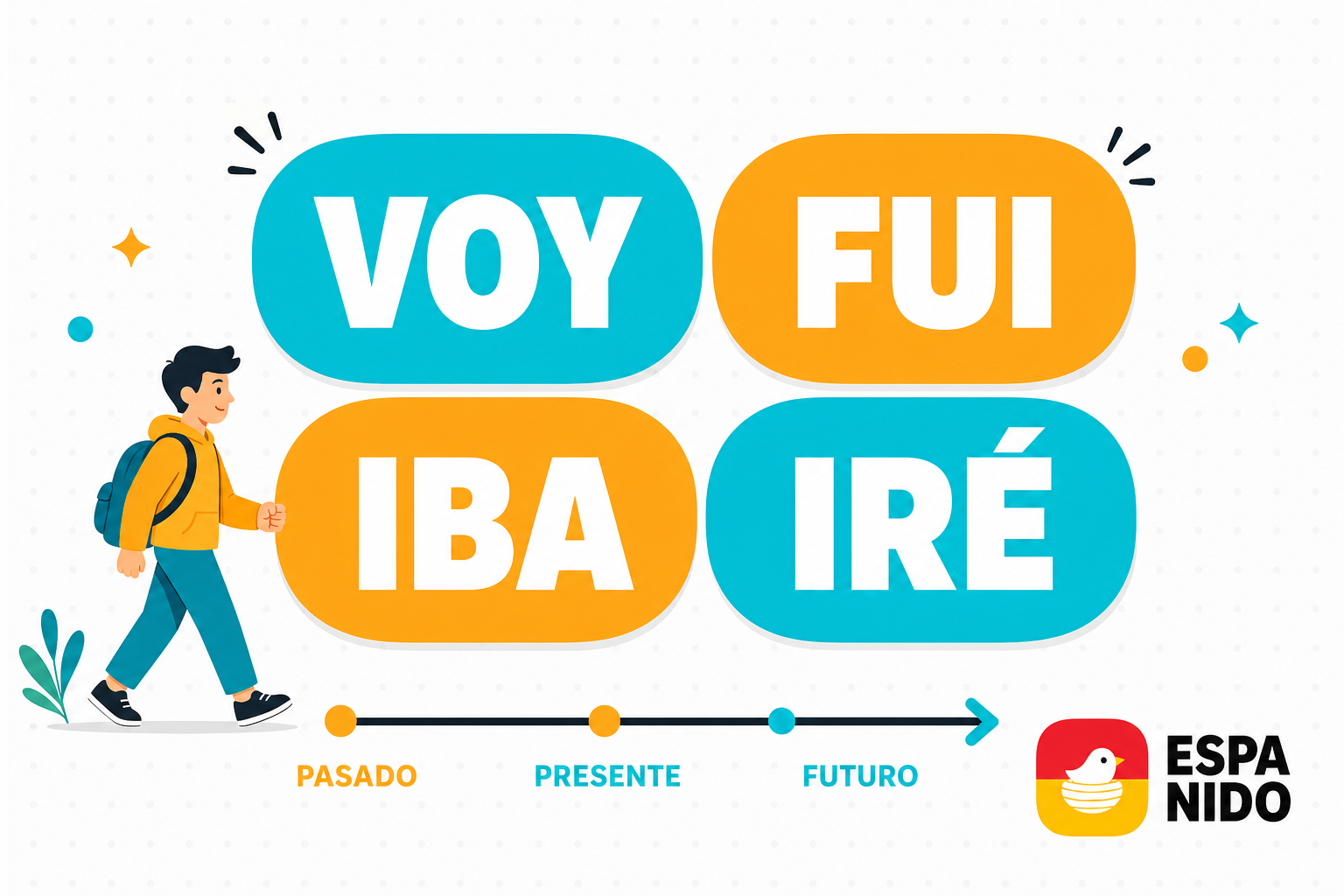
The quick difference between voy, fui, iba and iré
If a friend asks about your trips to Madrid, you could answer with four different forms of ir:
- Voy a Madrid hoy. — I am going to Madrid today.
- Fui a Madrid ayer. — I went to Madrid yesterday.
- Iba a Madrid cada verano. — I used to go to Madrid every summer.
- Iré a Madrid el próximo año. — I will go to Madrid next year.
Here’s the difference at a glance:
| Form | Tense | Basic meaning | Typical use |
|---|---|---|---|
| voy | Present | I go, I am going | Now, routines and near-future plans |
| fui | Preterite | I went | A completed past trip or event |
| iba | Imperfect | I was going, I used to go | Past habits, background and interrupted actions |
| iré | Future | I will go | Future plans, predictions and promises |
All four words are first-person singular forms, so they’re used with yo. Spanish often leaves out yo because the verb form already shows who is going.
Voy: I go or I am going
Voy is the present-tense form of ir for yo. Use it for something happening now, a regular activity or a planned trip.
- Voy al supermercado. — I am going to the supermarket.
- Voy al gimnasio los lunes. — I go to the gym on Mondays.
- Hoy voy en autobús. — Today I am going by bus.
A common pattern is ir a + infinitive. An infinitive is the basic form of a verb, such as comer, estudiar or viajar. This pattern expresses a plan or something that will happen soon.
- Voy a estudiar esta noche. — I am going to study tonight.
- Voy a llamar a Ana. — I am going to call Ana.
- Voy a viajar en junio. — I am going to travel in June.
Notice the two uses of a. When you go to a place, use ir a + place: Voy a la biblioteca. When you plan an action, use ir a + infinitive: Voy a leer.
You can review every present form on Espanido’s ir conjugation page. Then test yourself with the interactive ir conjugation exercise.
Fui: I went
Fui is the preterite form for yo. The preterite presents a past action as finished, and it’s common with time words such as ayer, anoche and el sábado pasado.
- Fui al médico ayer. — I went to the doctor yesterday.
- El sábado fui a una fiesta. — On Saturday I went to a party.
- Fui a México en 2022. — I went to Mexico in 2022.
Think of fui as a completed point on a timeline. The trip began and ended in the past.
Fui is also a form of ser, meaning to be. Context usually makes the meaning clear:
- Fui al banco. — I went to the bank. Here, fui comes from ir.
- Fui el capitán del equipo. — I was the team captain. Here, fui comes from ser.
A place introduced by a often signals movement, but you should always read the whole sentence. For more practice with completed actions, try the Spanish preterite exercise.
Iba: I was going or used to go
Iba is the imperfect form for yo. The imperfect describes an action that was in progress, happened regularly or formed the background of a past story.
- Iba al trabajo cuando empezó a llover. — I was going to work when it started to rain.
- De niño, iba al parque todos los días. — As a child, I used to go to the park every day.
- Antes iba en tren. — I used to go by train before.
Unlike fui, iba doesn’t focus on the end of the trip. It shows the action in progress or as part of a repeated routine.
Compare these two examples:
- Fui a la playa el domingo. — I went to the beach on Sunday.
- Iba a la playa todos los domingos. — I used to go to the beach every Sunday.
The first sentence describes one completed visit. The second describes a past habit.
The phrase iba a + infinitive can also describe a plan that existed in the past. Sometimes the plan happened, and sometimes it didn’t.
- Iba a cocinar, pero pedimos una pizza. — I was going to cook, but we ordered a pizza.
- Iba a llamarte. — I was going to call you.
Words such as siempre, a menudo, cada verano and cuando era niño often appear with the imperfect. They’re useful clues, but the meaning of the full sentence matters more than any single word.
For more practice distinguishing fui and iba, use Espanido’s past-tense comparison exercise.
Iré: I will go
Iré is the simple future form for yo. Use it to talk about a future trip, prediction, decision or promise.
- Iré a España el próximo verano. — I will go to Spain next summer.
- No te preocupes; iré contigo. — Don’t worry; I will go with you.
- Algún día iré a Buenos Aires. — One day I will go to Buenos Aires.
The written accent matters. Iré has an accent on the final é. Without it, the word is misspelled.
Spanish speakers often use voy a ir instead of iré, especially for a clear or near-future plan:
- Voy a ir al cine esta noche. — I am going to go to the cinema tonight.
- Iré al cine algún día. — I will go to the cinema someday.
The first example presents an existing plan. The second is a future statement, decision or less immediate idea. Both forms can sometimes describe the same event.
For focused work on future forms, try the simple future exercise.
Ir conjugation by tense
Here are the complete forms for the four tenses. The pronoun vosotros is mainly used in Spain. In most of Latin America, speakers use ustedes for plural you.
| Pronoun | Present | Preterite | Imperfect | Future |
|---|---|---|---|---|
| yo | voy | fui | iba | iré |
| tú | vas | fuiste | ibas | irás |
| él, ella, usted | va | fue | iba | irá |
| nosotros/as | vamos | fuimos | íbamos | iremos |
| vosotros/as | vais | fuisteis | ibais | iréis |
| ellos, ellas, ustedes | van | fueron | iban | irán |
The present and preterite forms are irregular, so they don’t follow the usual patterns. The imperfect forms begin with iba-, while the future keeps the full infinitive ir and adds future endings.
Start with groups such as voy, vas, va and fui, fuiste, fue. Put each form into a short sentence before studying the rest of the table.
A mini story with all four forms
Read this short story and notice how the timeline changes:
Ahora voy al trabajo en bicicleta. Antes iba en autobús todos los días. Ayer fui en taxi porque llovía. Mañana iré otra vez en bicicleta.
Now I go to work by bicycle. Before, I used to go by bus every day. Yesterday I went by taxi because it was raining. Tomorrow I will go by bicycle again.
The time expressions indicate the tense:
- Ahora points to voy.
- Antes and todos los días show the past habit iba.
- Ayer marks the completed action fui.
- Mañana points to the future form iré.
For practice, write four connected sentences about one place. Change only the time and the form of ir.
Common mistakes to avoid
Using fui for a repeated past habit
Incorrect: Cuando era niño, fui al parque todos los días.
Better: Cuando era niño, iba al parque todos los días. — When I was a child, I used to go to the park every day.
Use iba because this was a repeated background habit. Save fui for one finished visit: Ayer fui al parque.
Forgetting a after ir
Incorrect: Voy la escuela.
Correct: Voy a la escuela. — I go to school.
The verb ir normally uses a before a destination. When a meets the masculine article el, they combine as al: Voy al mercado.
Mixing voy and iré in the same construction
Incorrect: Voy a iré mañana.
Correct: Voy a ir mañana. — I am going to go tomorrow.
Also correct: Iré mañana. — I will go tomorrow.
After voy a, use the infinitive ir, not the future form iré.
Dropping written accents
The accents in iré, irá, iréis and irán are part of the spelling. The nosotros imperfect form also needs an accent: íbamos.
Quick practice
Choose voy, fui, iba or iré for each sentence.
- Ayer ___ al centro con Marta.
- Cuando vivía en Lima, ___ al mercado cada sábado.
- Ahora ___ a clase.
- El próximo año ___ a Colombia.
- ___ a cocinar, pero no había comida.
- Esta noche ___ a estudiar.
Answers:
- fui: The trip happened and finished yesterday.
- iba: This was a repeated past habit.
- voy: The action is happening now.
- iré: The trip is in the future.
- iba: Iba a cocinar describes a past plan.
- voy: Voy a estudiar expresses a near-future plan.
After checking your answers, repeat the Espanido ir exercise for more practice.
Frequently asked questions
What is the difference between fui and iba?
Fui describes a completed past trip: Fui a Sevilla ayer. Iba describes a past habit or an action in progress: Iba a Sevilla cada verano.
Is voy past, present or future?
Voy is a present-tense form. However, voy a + infinitive often talks about the near future: Voy a viajar mañana.
Why does fui mean both went and was?
The verbs ir and ser share the same preterite forms. Context tells you which verb is being used: Fui a casa means I went home, while Fui profesor means I was a teacher.
Can I use voy a ir instead of iré?
Often, yes. Voy a ir commonly expresses a plan, while iré can express a prediction, promise or future decision. The choice depends on what you want to emphasize.
How can I remember these forms?
Connect each form with a time clue: hoy voy, ayer fui, antes iba and mañana iré. Then create personal examples about places you visit.