Spanish adjectives: fix these five common mistakes
Spanish adjectives change according to the nouns they describe. If you've said una coche rojo or un bueno amigo, this guide explains what went wrong and how to correct it.
Want to practice right away? Start the adjetivos exercise.
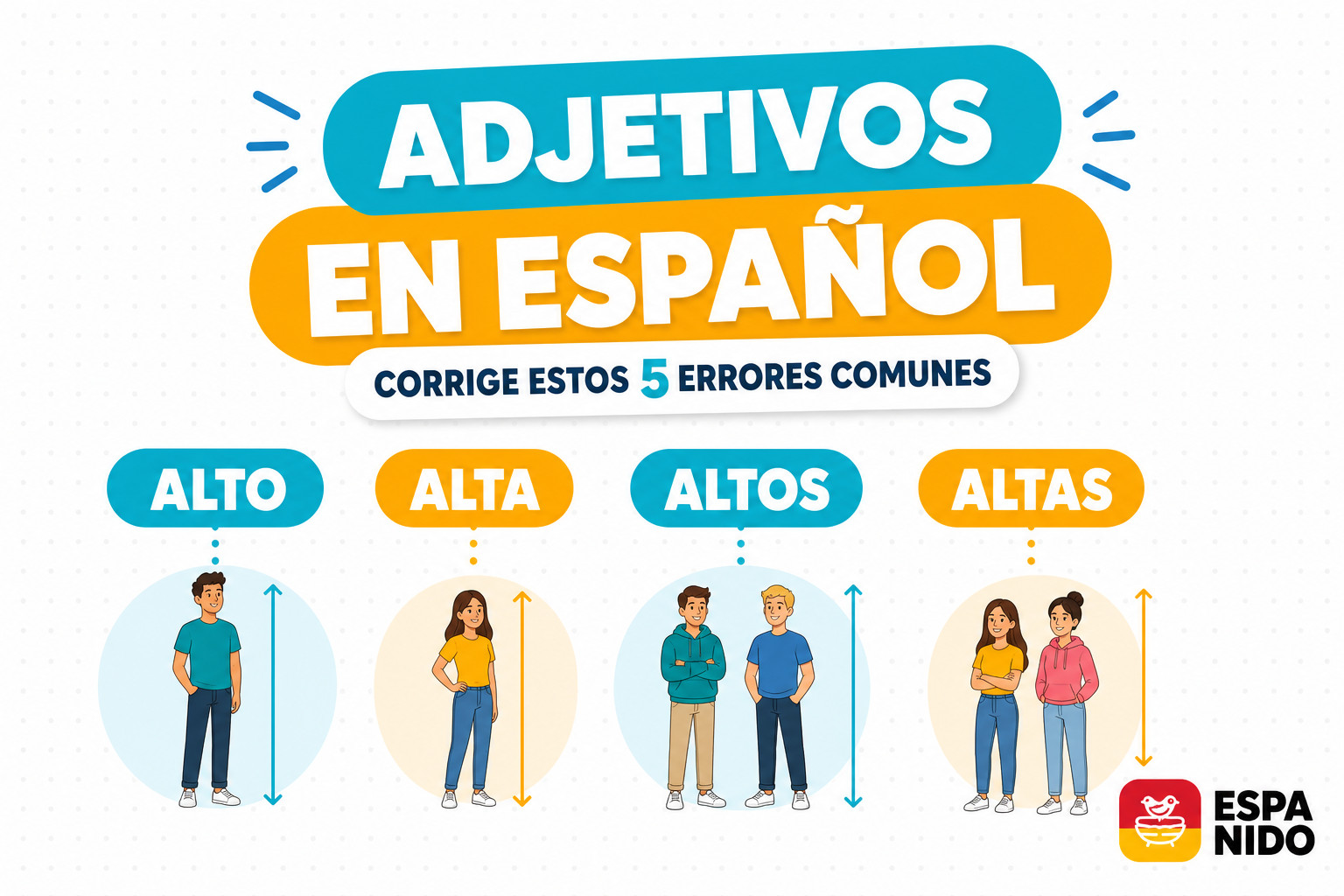
The basic rule for Spanish adjectives
An adjective describes a person, place, thing, or idea. Words such as bonito (pretty), grande (big), and interesante (interesting) are adjectives.
In Spanish, an adjective often changes to match the noun it describes. You also need to consider where the adjective goes and whether the sentence uses ser or estar.
Here is a simple example:
- un coche rojo: a red car
- una casa roja: a red house
- dos coches rojos: two red cars
- dos casas rojas: two red houses
The meaning of rojo stays the same, but its ending changes. This matching is called agreement: the noun and adjective agree in gender and number.
You can review these patterns in Espanido’s Spanish adjective guide before working through the five mistakes below.
Mistake 1: Not matching gender
A common mistake is using the masculine form of an adjective with every noun.
Incorrect:
- una casa bonito
Correct:
- una casa bonita: a pretty house
The noun casa is feminine, so bonito changes to bonita. With a masculine noun, you use bonito: un pueblo bonito means “a pretty town.”
Many adjectives ending in -o follow this pattern:
| Masculine | Feminine | English |
|---|---|---|
| alto | alta | tall |
| pequeño | pequeña | small |
| rojo | roja | red |
| cansado | cansada | tired |
However, not every adjective changes for gender. Adjectives ending in -e and many adjectives ending in consonants keep one form.
- un libro interesante: an interesting book
- una película interesante: an interesting movie
- un examen difícil: a difficult exam
- una pregunta difícil: a difficult question
Don't choose the adjective’s gender based on the person speaking. Match it with the noun being described.
For example, a woman can say Tengo un coche nuevo (“I have a new car”). The adjective is masculine because coche is masculine, not because of who owns it.
Watch out for nationality adjectives
Many nationality adjectives change even when the masculine form ends in a consonant:
- un escritor español: a Spanish writer
- una escritora española: a Spanish writer
- un estudiante francés: a French student
- una estudiante francesa: a French student
Learn a new noun with its article, such as la casa or el coche. Knowing the noun’s gender will help you choose the correct adjective form.
Mistake 2: Forgetting plural agreement
English adjectives don't become plural. We say “a red car” and “two red cars,” but the word “red” doesn't change.
Spanish adjectives usually do change:
Incorrect:
- dos coches rojo
- unas casas moderna
Correct:
- dos coches rojos: two red cars
- unas casas modernas: some modern houses
If an adjective ends in a vowel, you normally add -s:
- bonito → bonitos
- grande → grandes
- verde → verdes
If it ends in a consonant, you normally add -es:
- fácil → fáciles
- popular → populares
- azul → azules
Both gender and number may change at the same time:
| Noun phrase | Adjective form |
|---|---|
| el gato blanco | masculine singular |
| la gata blanca | feminine singular |
| los gatos blancos | masculine plural |
| las gatas blancas | feminine plural |
When one adjective describes a mixed group, Spanish normally uses the masculine plural form:
- Ana y Pablo están cansados.: Ana and Pablo are tired.
- La camisa y el pantalón son nuevos.: The shirt and the trousers are new.
Check each phrase in three steps: find the noun, identify its gender, and determine whether it's singular or plural.
Mistake 3: Putting every adjective before the noun
English usually places adjectives before nouns, as in “a small apartment” or “an interesting book.” In Spanish, descriptive adjectives often go after the noun.
Incorrect or unnatural in a basic description:
- un rojo coche
Natural:
- un coche rojo: a red car
Here are more examples:
- una mesa redonda: a round table
- un problema difícil: a difficult problem
- una ciudad tranquila: a peaceful city
- unos zapatos negros: some black shoes
Placing descriptive adjectives after the noun is a useful default. Colors, shapes, nationalities, and physical descriptions usually follow the noun.
Some adjectives can appear before it, especially when the speaker is adding an opinion or emphasis:
- una hermosa ciudad: a beautiful city
- una ciudad hermosa: a beautiful city
Both are possible, but the first can sound more expressive. The second is a direct description.
Position can change the meaning
Some Spanish adjectives have a different meaning depending on their position.
| Before the noun | After the noun |
|---|---|
| un viejo amigo: a longtime friend | un amigo viejo: an old friend |
| un gran hombre: a great man | un hombre grande: a big man |
| una pobre mujer: an unfortunate woman | una mujer pobre: a poor woman |
| cierta noticia: a certain piece of news | una noticia cierta: a true piece of news |
Start with the usual noun-plus-adjective order. You can then learn common changes in meaning as complete phrases.
Mistake 4: Saying bueno or grande in the wrong form
Some Spanish adjectives become shorter when they appear before certain nouns. This is called shortening, or apócope in Spanish.
A common example is bueno. Before a masculine singular noun, it becomes buen:
Incorrect:
- un bueno amigo
Correct:
- un buen amigo: a good friend
After the noun, it keeps its full form:
- un amigo bueno: a good or kind friend
Other adjectives have shortened forms too:
| Full form | Short form | Example |
|---|---|---|
| bueno | buen | un buen día: a good day |
| malo | mal | un mal resultado: a bad result |
| primero | primer | el primer día: the first day |
| tercero | tercer | el tercer piso: the third floor |
| alguno | algún | algún problema: some problem |
| ninguno | ningún | ningún mensaje: no message |
These forms are shortened before a masculine singular noun. Compare:
- un buen restaurante: a good restaurant
- una buena cafetería: a good café
- el primer capítulo: the first chapter
- la primera página: the first page
Grande works a little differently. It becomes gran before a singular noun of either gender when it means “great” or “important.”
- un gran escritor: a great writer
- una gran oportunidad: a great opportunity
- una casa grande: a big house
Here, position affects the meaning. Gran often means “great,” while grande after the noun usually refers to size.
Mistake 5: Mixing up ser and estar with adjectives
Choosing the correct adjective form is only part of the sentence. You may also need to choose between ser and estar, which both mean “to be.”
Use ser to identify or describe a general characteristic. Use estar for a state, condition, or how someone or something is at a particular time.
- Diego es aburrido.: Diego is boring.
- Diego está aburrido.: Diego is bored.
The adjective is the same, but the message changes. The first sentence describes Diego as a boring person, while the second tells us how he feels now.
Compare these pairs:
- La sopa es buena.: The soup is good.
- La sopa está buena.: The soup tastes good.
- Clara es lista.: Clara is clever.
- Clara está lista.: Clara is ready.
- El niño es tranquilo.: The child is calm by nature.
- El niño está tranquilo.: The child is calm right now.
Don't rely only on the idea that ser is permanent and estar is temporary. That shortcut doesn't explain every sentence.
Instead, ask whether you're describing what someone or something is like or its current state. You can study more examples with Espanido’s ser and estar practice exercises.
A checklist for Spanish adjectives
Before finishing a sentence, use this checklist:
- Find the noun. What person or thing does the adjective describe?
- Check gender. Is the noun masculine or feminine?
- Check number. Is it singular or plural?
- Check position. Does the adjective normally go after the noun?
- Check the verb. If you use “to be,” do you need ser or estar?
Imagine you want to say “The girls are tired.” Start with the noun: las chicas.
It's feminine and plural, so cansado becomes cansadas. Their tiredness is a current state, making the full sentence Las chicas están cansadas.
Now consider “They are hardworking girls.” The noun is still feminine and plural, but this is a general characteristic: Son chicas trabajadoras.
Mini practice: fix the mistakes
Correct these five sentences before checking the answers:
- Tengo una perro pequeño.
- Las flores son bonito.
- Compramos un nuevo coche rojo when you simply mean “We bought a new red car.”
- Es un bueno profesor.
- Marta es cansada hoy.
Answers
- Tengo un perro pequeño.: I have a small dog.
- Las flores son bonitas.: The flowers are pretty.
- Compramos un coche nuevo y rojo.: We bought a new red car.
- Es un buen profesor.: He is a good teacher.
- Marta está cansada hoy.: Marta is tired today.
For more exercises, use Espanido’s Spanish adjectives practice and check why each answer is right or wrong.
Frequently asked questions
Do Spanish adjectives always go after the noun?
No. Descriptive adjectives often go after the noun, but some can go before it for emphasis, style, or a different meaning. The noun-plus-adjective order is a useful starting point.
Do all Spanish adjectives have masculine and feminine forms?
No. Adjectives ending in -o often change to -a, but adjectives such as interesante, verde, and difícil use the same form for masculine and feminine nouns. They still change for the plural: interesantes, verdes, and difíciles.
What happens when an adjective describes two nouns?
Use a plural adjective. If the nouns include both masculine and feminine forms, traditional standard Spanish normally uses the masculine plural: el libro y la revista nuevos (“the new book and magazine”).
Is adjective agreement important in conversation?
Yes, although a small agreement mistake won't usually prevent understanding. Focus on clear communication and practice the same patterns in different sentences.
Keep the four matches in mind
Spanish adjective use depends mainly on matching the adjective with the noun’s gender and number, placing it in a suitable position, and choosing ser or estar based on the meaning.
Start with phrases such as una casa bonita, unos libros interesantes, and estoy cansado or estoy cansada. Then apply the same patterns to other nouns and adjectives.