Spanish articles: when to use el, la, un and una
You see el, la, un, and una everywhere in Spanish: el libro, la casa, un café, una pregunta. These small words are Spanish articles, and learning how they work will make your sentences sound much more natural.
Want to practice right away? Start the articulos definidos e indefinidos exercise.
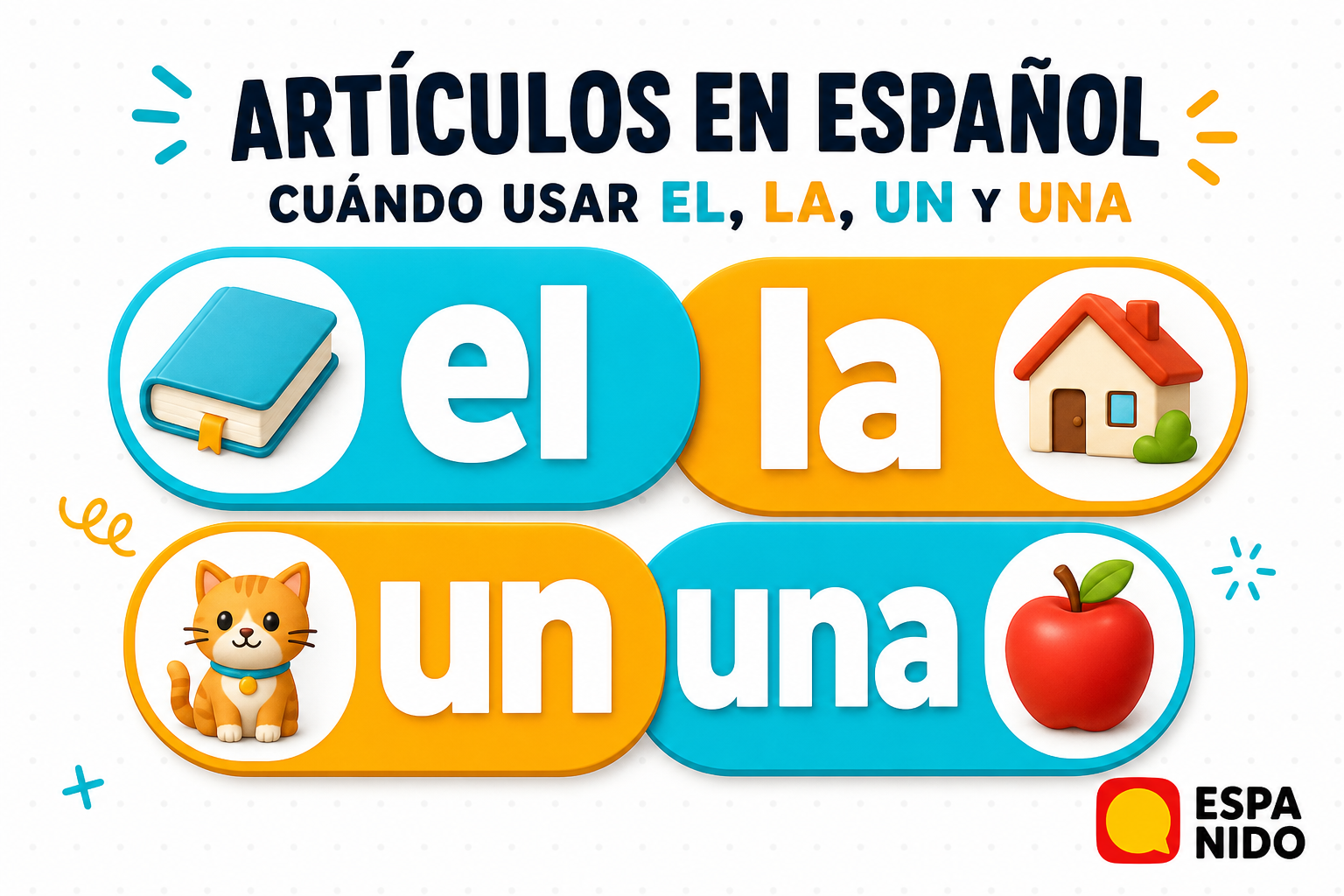
The basic choice is simple. Use el or la when you mean “the,” and use un or una when you mean “a” or “an.” You also need to match the article to the noun’s gender.
The quick answer
Here is the main pattern for singular nouns:
| Article | Meaning | Used with | Example |
|---|---|---|---|
| el | the | masculine nouns | el libro — the book |
| la | the | feminine nouns | la mesa — the table |
| un | a or an | masculine nouns | un libro — a book |
| una | a or an | feminine nouns | una mesa — a table |
Compare these two short conversations:
- Necesito un bolígrafo. — I need a pen.
- Aquí está el bolígrafo. — Here is the pen.
In the first sentence, the speaker needs a pen, but not a particular one. In the second, both people know which pen they mean.
That difference—general or unidentified versus specific or known—is the key to choosing the right Spanish article.
When to use el and la
El and la are definite articles. A definite article points to a specific person, place, thing, or idea. In English, both words usually mean “the.”
Use el with a singular masculine noun:
- el coche — the car
- el teléfono — the phone
- el problema — the problem
Use la with a singular feminine noun:
- la puerta — the door
- la ciudad — the city
- la noche — the night
When the noun is already known
Imagine that you are in a café. You order un café because you are introducing it into the conversation. A few minutes later, you can say:
- El café está frío. — The coffee is cold.
You now use el because it refers to the particular coffee you ordered.
The same pattern works in this example:
- Compré una camisa. La camisa es azul. — I bought a shirt. The shirt is blue.
First it is one unknown shirt. After you mention it, it becomes the specific shirt in the conversation.
When there is only one clear thing
Use el or la when the situation makes the meaning clear:
- Cierra la puerta. — Close the door.
- El sol está brillante. — The sun is bright.
- Voy al banco. — I’m going to the bank.
The speaker expects the listener to understand which door, sun, or bank is meant.
When talking about things in general
Spanish often uses el, la, los, or las for a whole category. English may use no article in the same sentence.
- Me gusta el chocolate. — I like chocolate.
- La música es importante para mí. — Music is important to me.
- Los perros son animales sociales. — Dogs are social animals.
A common beginner mistake is to translate directly from English and say Me gusta chocolate. In standard Spanish, Me gusta el chocolate is the natural choice when talking about chocolate in general.
When to use un and una
Un and una are indefinite articles. They usually mean “a” or “an,” and they introduce someone or something that is not yet specific.
Use un with a singular masculine noun:
- un amigo — a friend
- un hotel — a hotel
- un día — a day
Use una with a singular feminine noun:
- una amiga — a friend
- una habitación — a room
- una idea — an idea
When mentioning something for the first time
Use an indefinite article when the listener does not yet know the person or thing:
- Hay un gato en el jardín. — There is a cat in the garden.
- Tengo una pregunta. — I have a question.
- Buscamos un restaurante. — We are looking for a restaurant.
The cat, question, and restaurant are new information.
When any member of a group will work
Use un or una when you do not have one specific thing in mind:
- Quiero comprar un diccionario. — I want to buy a dictionary.
- Necesitamos una mesa para cuatro. — We need a table for four.
- ¿Tienes un lápiz? — Do you have a pencil?
The speaker wants one dictionary, table, or pencil, but has not identified a particular one.
When describing one person or thing
An indefinite article can place a person or object in a group:
- Madrid es una ciudad grande. — Madrid is a large city.
- Es un libro interesante. — It is an interesting book.
- Marta es una persona amable. — Marta is a kind person.
Notice that the article agrees with the noun, not with the person being discussed. Persona is feminine, so you say una persona even when talking about a man.
How to know whether a noun is masculine or feminine
Spanish nouns have grammatical gender. This does not always refer to natural gender; it is simply part of how the noun works.
Many nouns ending in -o are masculine, while many nouns ending in -a are feminine:
- el libro — the book
- un zapato — a shoe
- la ventana — the window
- una silla — a chair
This is a helpful pattern, but it is not a perfect rule. For example:
- el problema — the problem
- el mapa — the map
- la mano — the hand
- la foto — the photo
It is best to learn each new noun with its article. Instead of memorizing only mano, learn la mano. Instead of learning only problema, learn el problema.
If noun gender still feels uncertain, review Espanido’s guide and activities for the gender of Spanish nouns. It will help you see the common endings and the most useful exceptions.
What happens with plural nouns?
The plural forms follow the same idea:
| Singular | Plural | Meaning |
|---|---|---|
| el | los | the |
| la | las | the |
| un | unos | some or a few |
| una | unas | some or a few |
Examples:
- el libro → los libros — the book → the books
- la casa → las casas — the house → the houses
- un amigo → unos amigos — a friend → some friends
- una pregunta → unas preguntas — a question → some questions
Unos and unas often mean “some” or “a few” rather than simply marking a plural:
- Compré unos tomates. — I bought some tomatoes.
- Necesito unas cajas. — I need a few boxes.
The article and noun must both match. You cannot say la libros or un casas. Use los libros and unas casas.
You can reinforce this pattern with Espanido’s Spanish article rules and examples.
When Spanish leaves out the article
Spanish articles are common, but they are not used before every noun. A few situations are especially useful for beginners.
Jobs after ser
Normally, do not use un or una before a profession after ser:
- Soy profesora. — I am a teacher.
- Carlos es médico. — Carlos is a doctor.
- Mi hermana es ingeniera. — My sister is an engineer.
However, the article can return when the profession has a description:
- Es una profesora excelente. — She is an excellent teacher.
- Carlos es un médico muy conocido. — Carlos is a very well-known doctor.
Languages after hablar, estudiar and saber
Articles are often left out after verbs such as hablar, estudiar, and saber:
- Hablo español. — I speak Spanish.
- Estudiamos francés. — We study French.
- Ana sabe italiano. — Ana knows Italian.
But the article can appear when the language is the subject or when you describe it:
- El español es bonito. — Spanish is beautiful.
- El francés que habla Ana es muy claro. — The French that Ana speaks is very clear.
After hay
Use an indefinite article after hay when talking about one non-specific item:
- Hay un supermercado cerca. — There is a supermarket nearby.
- Hay una carta para ti. — There is a letter for you.
Do not normally use el or la directly after hay. The purpose of hay is often to introduce something, not point to a known item.
Special cases that confuse beginners
A few forms may look strange at first, but the patterns are manageable.
El agua, not la agua
Some feminine nouns beginning with a stressed a sound use el in the singular because it is easier to pronounce:
- el agua fría — the cold water
- el águila blanca — the white eagle
- el aula grande — the large classroom
These nouns are still feminine. That is why the adjective is feminine: fría, blanca, and grande where gender is not visible. In the plural, use las: las aguas, las águilas, and las aulas.
The same pronunciation pattern affects una, which may become un: un águila. In everyday usage, you may hear some variation, but un águila is the standard form.
Al and del
When a comes before el, they combine to form al:
- Voy al mercado. — I’m going to the market.
When de comes before el, they combine to form del:
- Vengo del mercado. — I’m coming from the market.
Do not combine these words with la:
- Voy a la tienda. — I’m going to the shop.
- Vengo de la tienda. — I’m coming from the shop.
Common mistakes and quick fixes
Mistake: matching the article to the speaker
Incorrect: Soy una estudiante only because the speaker is female, without checking the noun.
Better rule: match the article to the noun. Here, estudiante can refer to any gender, and the surrounding words or context show who is meant. With professions after ser, the most natural basic sentence is often Soy estudiante—“I am a student.”
Mistake: assuming every -a noun is feminine
Incorrect: la problema
Correct: el problema — the problem
Learn frequent exceptions as complete pairs. Saying el problema several times is more useful than memorizing a long list of grammar labels.
Mistake: dropping articles in general statements
Less natural: Perros son inteligentes.
Correct: Los perros son inteligentes. — Dogs are intelligent.
Spanish usually uses a definite article when discussing a complete category.
Mistake: using el for every English “the”
English has one word, “the,” but Spanish articles must match the noun:
- el hotel — the hotel
- la playa — the beach
- los hoteles — the hotels
- las playas — the beaches
Before choosing an article, ask two questions: Is the noun specific or non-specific? Is it masculine or feminine?
A simple three-step method
When you need an article, use this quick check:
- Is the noun specific or already known? Choose el, la, los, or las.
- Is it one non-specific or newly introduced thing? Choose un or una.
- What is the noun’s gender and number? Make the article match.
Try it with this mini story:
- Veo un perro. — I see a dog.
- El perro lleva una pelota. — The dog is carrying a ball.
- La pelota es roja. — The ball is red.
The dog and ball first appear with indefinite articles. Once they are known, the story changes to definite articles.
Practice Spanish articles
Reading the rule helps, but choosing articles in real sentences makes the pattern stick. Complete Espanido’s el, la, un and una practice exercises and pay attention to why each noun is specific, non-specific, masculine, or feminine.
Do not worry if you need to check the noun’s gender at first. With regular practice, pairs such as el libro, la casa, un problema, and una mano will begin to sound automatic.
Frequently asked questions
What is the difference between el and un?
El means “the” and points to a specific masculine noun. Un means “a” or “an” and introduces a non-specific masculine noun: el coche is “the car,” while un coche is “a car.”
What is the difference between la and una?
La means “the” for a feminine singular noun. Una means “a” or “an”: la casa is “the house,” while una casa is “a house.”
Is el masculine and la feminine?
Usually, yes. El goes with masculine singular nouns, and la goes with feminine singular nouns. A small group of feminine nouns, such as agua, uses el in the singular for pronunciation: el agua fría.
Do Spanish articles always match the noun?
Yes. The article matches the noun’s grammatical gender and number. For example, use la mesa, las mesas, el libro, and los libros.
Why does Spanish use articles more often than English?
Spanish commonly uses definite articles for general ideas and categories. English says “I like music,” while Spanish usually says Me gusta la música—literally, “I like the music.”
The main point to remember
Use el and la for a specific or known noun. Use un and una when introducing one non-specific noun. Then make sure the article matches the noun’s gender.
Start by learning nouns together with their articles, such as el día, la mano, un problema, and una ciudad. This small habit will help you choose Spanish articles faster and speak with more confidence.