How to form the Spanish conditional perfect
The Spanish conditional perfect lets you talk about what would have happened under different conditions. The formula is a conditional form of haber plus a past participle, as in habría hablado: “I would have spoken.”
Want to practice right away? Start the condicional compuesto exercise.
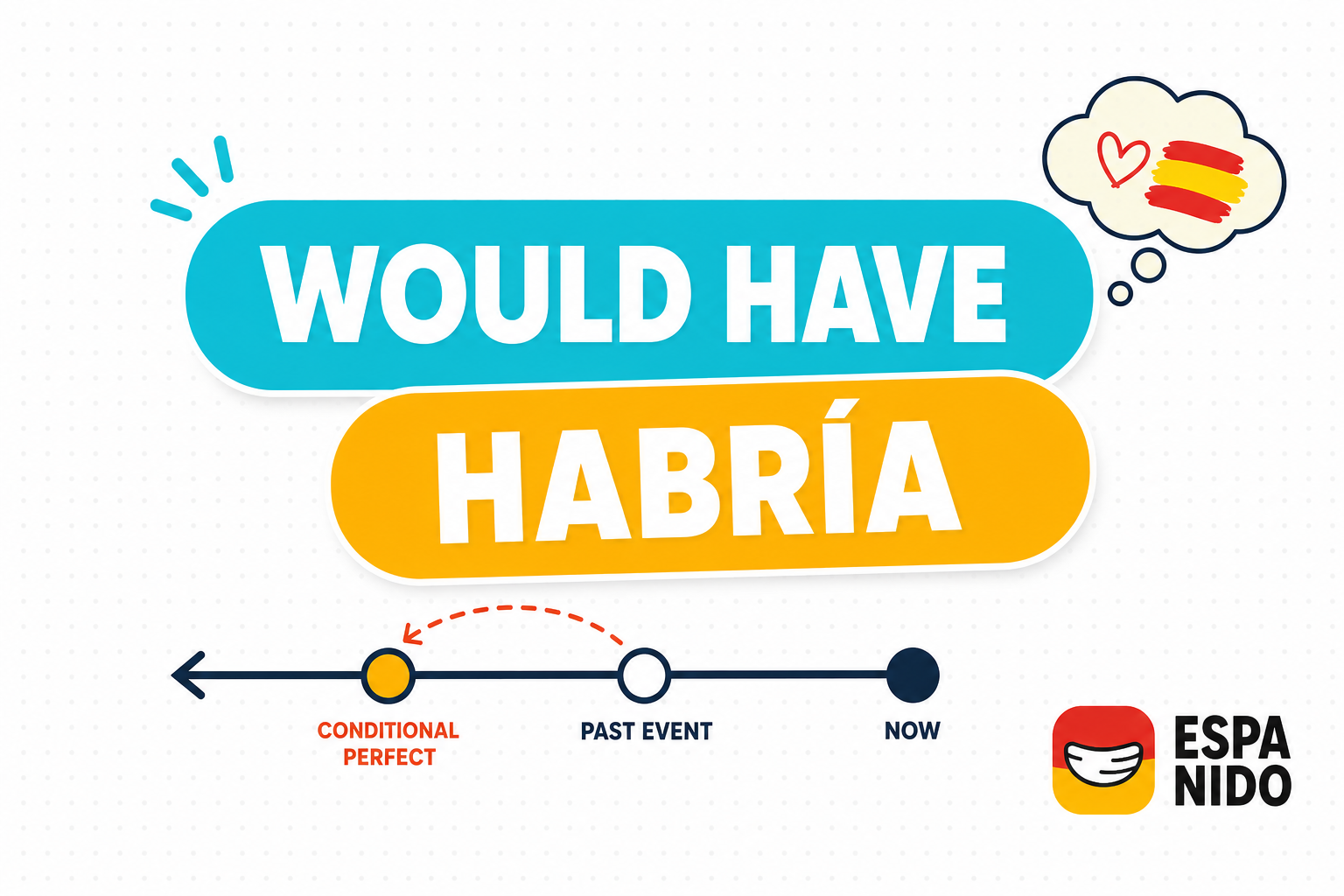
The conditional perfect in one sentence
Use the Spanish conditional perfect to describe an action that would have happened but didn't, or to make a guess about something in the past.
Here are two examples:
- Habría ido, pero estaba enfermo.: “I would have gone, but I was sick.”
- ¿Por qué no llegó Ana? Habría perdido el tren.: “Why didn’t Ana arrive? She probably missed the train.”
The first sentence imagines a different past. The second makes a guess about a past event.
In Spanish, this tense is called the condicional compuesto. You may also see it called the conditional perfect tense.
The basic formula
To form the Spanish conditional perfect, use:
conditional form of haber + past participle
For example:
- Yo habría hablado.: “I would have spoken.”
- Tú habrías comido.: “You would have eaten.”
- Ellos habrían salido.: “They would have left.”
Only haber changes to match the subject. The past participle stays the same.
| Subject | Conditional form of haber | Example with viajar |
|---|---|---|
| yo | habría | habría viajado |
| tú | habrías | habrías viajado |
| él, ella, usted | habría | habría viajado |
| nosotros, nosotras | habríamos | habríamos viajado |
| vosotros, vosotras | habríais | habríais viajado |
| ellos, ellas, ustedes | habrían | habrían viajado |
Notice the accent in every form: habría, habrías, habríamos, habríais, and habrían. These accents show where the stress falls.
How to make the past participle
The past participle is the verb form used after haber. English examples include “spoken,” “eaten,” and “lived.”
For regular Spanish verbs, remove the infinitive ending and add the participle ending:
| Infinitive ending | Add | Example |
|---|---|---|
| -ar | -ado | hablar → hablado |
| -er | -ido | comer → comido |
| -ir | -ido | vivir → vivido |
Next, place the participle after the correct form of haber:
- Habríamos hablado con ella.: “We would have spoken with her.”
- Carlos habría comido antes.: “Carlos would have eaten earlier.”
- Mis amigos habrían vivido allí.: “My friends would have lived there.”
The participle doesn't change for gender or number when it follows haber. Say María habría llegado and María y Ana habrían llegado, not llegada or llegadas.
Common irregular past participles
Some frequent verbs have irregular past participles. The form of haber stays regular, but the participle takes a different form.
| Verb | Past participle | Conditional perfect example |
|---|---|---|
| abrir: to open | abierto | Habría abierto la puerta. |
| decir: to say | dicho | Habrías dicho la verdad. |
| escribir: to write | escrito | Habríamos escrito antes. |
| hacer: to do or make | hecho | Habrían hecho la cena. |
| morir: to die | muerto | La planta habría muerto. |
| poner: to put | puesto | Habría puesto la mesa. |
| romper: to break | roto | Habrías roto el vaso. |
| ver: to see | visto | Habríamos visto el museo. |
| volver: to return | vuelto | Ellos habrían vuelto. |
It helps to learn these as complete pairs, such as habría hecho, habría dicho, and habría visto. That way, you learn each participle in the tense where it's used.
When to use the Spanish conditional perfect
To imagine a different past
A common use is talking about something that didn't happen because the real situation was different.
Imagine that Marta missed a concert because she had to work. She says:
Habría ido al concierto, pero tenía que trabajar.: “I would have gone to the concert, but I had to work.”
The concert is over, and Marta didn't go. The conditional perfect shows the imagined result.
More examples:
- Te habría llamado, pero perdí tu número.: “I would have called you, but I lost your number.”
- Habríamos comprado la casa, pero era demasiado cara.: “We would have bought the house, but it was too expensive.”
- Ellos habrían llegado antes, pero había mucho tráfico.: “They would have arrived earlier, but there was a lot of traffic.”
In past “if” sentences
The conditional perfect often appears in sentences about an unreal past condition. These sentences commonly follow this pattern:
si + past perfect subjunctive, conditional perfect
- Si hubiera estudiado, habría aprobado el examen.: “If I had studied, I would have passed the exam.”
- Si hubieras venido, lo habrías conocido.: “If you had come, you would have met him.”
- Si no hubiera llovido, habríamos ido a la playa.: “If it had not rained, we would have gone to the beach.”
The part after si gives the unreal condition. The conditional perfect gives its imagined result.
You can switch the two parts without changing the meaning:
Habríamos ido a la playa si no hubiera llovido.: “We would have gone to the beach if it had not rained.”
Don't normally put the conditional perfect directly after si. In standard Spanish, use si hubiera/hubiese + participle, not si habría + participle.
To make a guess about the past
The conditional perfect can also show uncertainty or a guess about something that had already happened.
The simple conditional can serve a similar purpose: Habría unas veinte personas means “There were probably about twenty people.” With the conditional perfect, the guess concerns a completed past action:
- Habrían salido antes de las ocho.: “They had probably left before eight.”
- ¿Quién habría llamado tan tarde?: “Who could have called so late?”
- No lo sé; se habría olvidado.: “I don’t know; he or she probably forgot.”
Context tells you whether the speaker means “would have” or is making a past guess.
To report a future perfect idea from a past viewpoint
The conditional perfect also appears in reported speech. It can describe something that was expected to be complete later, viewed from a point in the past.
Direct statement:
Para el viernes habré terminado.: “By Friday, I will have finished.”
Reported later:
Dijo que para el viernes habría terminado.: “He said that by Friday he would have finished.”
This use appears in stories, news, and formal writing.
How to make negative sentences and questions
For a negative sentence, put no before the form of haber:
- No habría aceptado la oferta.: “I would not have accepted the offer.”
- No habríamos salido tan tarde.: “We would not have left so late.”
- Ellos nunca habrían hecho eso.: “They would never have done that.”
Object pronouns also go before haber:
- Lo habría comprado.: “I would have bought it.”
- Te habríamos ayudado.: “We would have helped you.”
- No se lo habría dicho.: “I would not have told it to him or her.”
To ask a question, keep the same verb form and use question marks:
- ¿Habrías venido conmigo?: “Would you have come with me?”
- ¿Qué habrías hecho?: “What would you have done?”
- ¿Dónde habrían dormido?: “Where would they have slept?”
Conditional perfect versus simple conditional
The simple conditional talks about what someone would do. The conditional perfect talks about what someone would have done.
| Tense | Example | Meaning |
|---|---|---|
| Simple conditional | Viajaría a México. | “I would travel to Mexico.” |
| Conditional perfect | Habría viajado a México. | “I would have traveled to Mexico.” |
Compare these sentences:
Viajaría contigo el próximo año.: “I would travel with you next year.”
Habría viajado contigo el año pasado, pero no tenía dinero.: “I would have traveled with you last year, but I didn’t have money.”
The first trip is still a possibility. The second belongs to an unreal past.
For more practice with the first form, try Espanido’s simple conditional exercise. It shows the difference between haría and habría hecho.
Common mistakes to avoid
Using the infinitive after haber
Incorrect: Habría comprar la casa.
Correct: Habría comprado la casa.: “I would have bought the house.”
The conditional perfect needs a past participle after haber.
Conjugating both verbs
Incorrect: Habríamos compramos la casa.
Correct: Habríamos comprado la casa.: “We would have bought the house.”
Only haber matches the subject. The participle remains unchanged.
Changing the participle for gender or number
Incorrect: Ellas habrían llegadas temprano.
Correct: Ellas habrían llegado temprano.: “They would have arrived early.”
A participle used with haber doesn't agree with the subject.
Forgetting the accent in haber
Incorrect: habria, habriamos
Correct: habría, habríamos
Every conditional form of haber has a written accent on the í.
Using habría after si
Incorrect: Si habría sabido, te habría llamado.
Correct: Si hubiera sabido, te habría llamado.: “If I had known, I would have called you.”
The result uses the conditional perfect. The unreal condition after si normally uses hubiera or hubiese plus a participle.
A quick way to build your own sentences
Start with a real past event: “I did not go because I was tired.” Then imagine the alternative:
- Choose the subject: yo.
- Select the matching form of haber: habría.
- Make the participle of ir: ido.
- Add the real reason: pero estaba cansado.
The result is:
Habría ido, pero estaba cansado.: “I would have gone, but I was tired.”
Try the same process with these prompts:
- We did not eat there because it was closed.
- She did not call because she was busy.
- They did not buy the tickets because they were expensive.
Possible answers are:
- Habríamos comido allí, pero estaba cerrado.: “We would have eaten there, but it was closed.”
- Ella habría llamado, pero estaba ocupada.: “She would have called, but she was busy.”
- Habrían comprado las entradas, pero eran caras.: “They would have bought the tickets, but they were expensive.”
Use the Spanish conditional perfect exercise on Espanido to practice choosing the correct form in full sentences. You can also review the conditional perfect rule and examples before starting.
A simple memory trick
Think of the conditional perfect as a backward-looking “would have.”
First, choose the “would have” helper: habría, habrías, habríamos, habríais, or habrían. Then add a participle such as hablado, comido, vivido, hecho, or visto.
Habría + participle = would have + past participle
For example, habría visto means “would have seen,” while habríamos hecho means “we would have done.”
Frequently asked questions
What is haber in the conditional perfect?
Haber is the helping verb in this tense. Its conditional forms are habría, habrías, habría, habríamos, habríais, and habrían.
What does habría mean in English?
Before a past participle, habría often means “I would have,” “he would have,” “she would have,” or “you would have.” The subject and context show which meaning is correct.
Is habría habido correct?
Yes. It means “there would have been” or, in some contexts, “there had probably been.” For example, Habría habido más gente si no hubiera llovido means “There would have been more people if it had not rained.”
Does the past participle agree with the subject?
No. After haber, it stays unchanged. Use habría llegado for one woman, one man, or any formal singular subject.
What is the difference between habría hecho and haría?
Haría means “I, he, she, or you would do.” Habría hecho means “I, he, she, or you would have done,” so it looks back at an imagined or uncertain past.
Final check
To form the Spanish conditional perfect, conjugate haber in the conditional and add a past participle. Use it mainly for unreal past results, past guesses, and future events reported from a past viewpoint.
When you write a sentence, check three things: the correct form of haber, the correct past participle, and the accent on í.