When to use ser and estar in Spanish correctly
Both ser and estar mean “to be,” but Spanish uses them for different kinds of information. The best way to choose correctly is to ask what you are describing: identity, a state, a location, or an event.
Want to practice right away? Start the verbo ser y estar exercise.
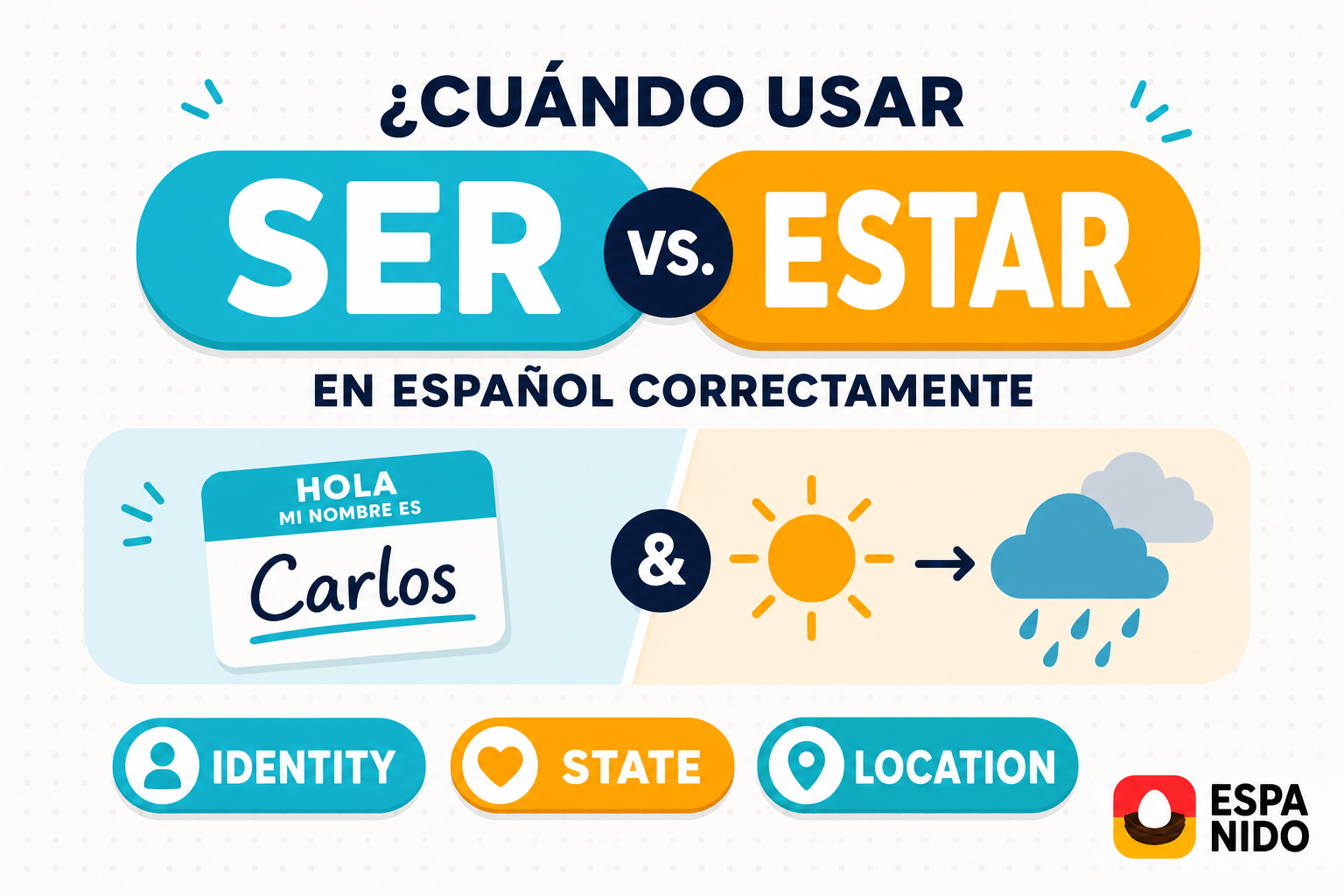
The short answer: ser describes what something is
Use ser to identify, define, or classify someone or something. Use estar to talk about a condition, location, result, or action in progress.
Compare these examples:
- Ana es tranquila. — Ana is a calm person.
- Ana está tranquila. — Ana is calm right now.
The English translation is almost the same, but the Spanish meaning changes. The first sentence describes Ana’s character. The second describes her current state.
A useful starting point is:
- Ser answers questions such as “What is it?” or “What is this person like?”
- Estar answers questions such as “How is it now?” or “Where is it?”
This is more reliable than the common “permanent versus temporary” rule. That shortcut can help at first, but it does not explain every case.
Present tense forms of ser and estar
Here are the present tense forms you will use most often:
| Subject | Ser | Estar |
|---|---|---|
| yo | soy | estoy |
| tú | eres | estás |
| él, ella, usted | es | está |
| nosotros/as | somos | estamos |
| vosotros/as | sois | estáis |
| ellos, ellas, ustedes | son | están |
Notice the written accents in estás, está, and están. These accents are part of the correct spelling.
If the forms are still new, review the ser and estar rules on Espanido before trying the examples below.
When to use ser
Identity and classification
Use ser to say who or what someone or something is. This includes names, jobs, roles, and categories.
- Soy Elena. — I am Elena.
- Pablo es médico. — Pablo is a doctor.
- Esto es un problema. — This is a problem.
- Los gatos son animales. — Cats are animals.
Spanish often leaves out the article before a profession. For example, say Es profesora, not normally Es una profesora, when you are simply naming someone’s profession.
Origin and nationality
Use ser to say where someone or something comes from.
- Somos de Canadá. — We are from Canada.
- Lucía es española. — Lucía is Spanish.
- El café es de Colombia. — The coffee is from Colombia.
A person may move to another country, but this information still uses ser because it describes origin, not current location.
General characteristics
Use ser for qualities that describe the person or thing itself.
- Mi hermano es alto. — My brother is tall.
- La película es interesante. — The movie is interesting.
- Estas calles son estrechas. — These streets are narrow.
These qualities do not need to last forever. A child can grow taller, and opinions about a movie can change. The point is that you are describing a characteristic, not a current condition.
Time and dates
Clock time, days, and dates use ser.
- Es la una. — It is one o’clock.
- Son las ocho. — It is eight o’clock.
- Hoy es lunes. — Today is Monday.
- Mañana es el 12 de mayo. — Tomorrow is May 12.
Use singular es for one o’clock and plural son for other times.
Relationships, ownership, and material
Use ser to describe relationships and to say what something belongs to or is made from.
- Clara es mi prima. — Clara is my cousin.
- El libro es de Mateo. — The book belongs to Mateo.
- La mesa es de madera. — The table is made of wood.
The phrase ser de can therefore express origin, ownership, or material. The surrounding words make the meaning clear.
The location of an event
Events use ser when you say where they take place.
- La reunión es en la oficina. — The meeting is in the office.
- El concierto es en el parque. — The concert is in the park.
- La fiesta es en mi casa. — The party is at my house.
This is an important exception to the usual location rule. People and objects are located with estar, but events are held with ser.
When to use estar
The location of people and things
Use estar to say where a person, object, or place is located.
- Marta está en casa. — Marta is at home.
- Las llaves están en la mesa. — The keys are on the table.
- Madrid está en España. — Madrid is in Spain.
Madrid’s location is not temporary, but Spanish still uses estar. This is one reason the “temporary versus permanent” rule is not enough.
Compare the event exception:
- El museo está en el centro. — The museum is downtown.
- La exposición es en el museo. — The exhibition is at the museum.
The museum is a place, so its location uses estar. The exhibition is an event, so its location uses ser.
Feelings and conditions
Use estar for emotions, health, appearance, and other states.
- Estoy cansado. — I am tired.
- Estamos felices. — We are happy.
- La sopa está fría. — The soup is cold.
- ¿Cómo estás? — How are you?
These sentences describe how someone or something is at that moment. The state may change, but change is not required for estar to be correct.
Results of an action
Use estar when something is in a state caused by an earlier action.
- La puerta está cerrada. — The door is closed.
- El vaso está roto. — The glass is broken.
- La cena está preparada. — Dinner is prepared.
Someone closed the door, broke the glass, or prepared dinner. The sentence focuses on the resulting state, not the action itself.
Actions happening now
Use estar with a gerund to describe an action in progress. A gerund is the Spanish -ando or -iendo form, similar to an English verb ending in “-ing.”
- Estoy estudiando. — I am studying.
- Estamos comiendo. — We are eating.
- Los niños están jugando. — The children are playing.
This structure is called the present progressive. Use it when you want to stress that the action is happening around the present moment.
Adjectives that change meaning with ser and estar
Some adjectives can follow either verb, but the choice changes the message. These pairs are worth learning as complete examples.
| With ser | Meaning | With estar | Meaning |
|---|---|---|---|
| Es aburrido. | He or it is boring. | Está aburrido. | He is bored. |
| Es listo. | He is clever. | Está listo. | He or it is ready. |
| Es rico. | He is rich. | Está rico. | It tastes delicious. |
| Es seguro. | It is safe or reliable. | Está seguro. | He is certain. |
| Es verde. | It is green in color. | Está verde. | It is unripe. |
Imagine a friend waiting for dinner. Carlos es aburrido means Carlos is a boring person. Carlos está aburrido means he needs something interesting to do.
The verb does more than mark time. It tells the listener whether the adjective describes a defining quality or a current state or reaction.
Why “permanent versus temporary” causes mistakes
Many learners are taught that ser is permanent and estar is temporary. It works for examples such as Soy inglés and Estoy cansado, but it quickly creates problems.
Consider these sentences:
- Madrid está en España. — Madrid is in Spain.
- Está muerto. — He is dead.
- La fiesta es mañana. — The party is tomorrow.
Madrid’s location and death are not temporary, yet both sentences use estar. A party may last only two hours, yet its date uses ser.
Instead of asking how long something lasts, ask what kind of information you are giving. Identity and definition normally use ser, while location and condition normally use estar.
A quick decision guide
When you need to choose between ser and estar, follow these steps:
- Is it an action happening now? Use estar plus a gerund: Estoy leyendo.
- Is it the location of a person or thing? Use estar: El banco está aquí.
- Is it the location of an event? Use ser: La boda es aquí.
- Is it identity, origin, time, material, or a relationship? Use ser.
- Is it a feeling, condition, appearance, or result? Use estar.
- Is there an adjective? Ask whether it describes a general quality or the current state.
You do not need to process every rule during a real conversation. With repeated practice, common combinations such as estar cansado, ser de México, and ser las tres begin to feel automatic.
Common mistakes to avoid
Using ser for physical location
Incorrect: Mi teléfono es en la cocina.
Correct: Mi teléfono está en la cocina. — My phone is in the kitchen.
A phone is an object, so its location takes estar.
Using estar for professions
Incorrect: Estoy estudiante.
Correct: Soy estudiante. — I am a student.
Being a student is a role or classification. If you want to describe a temporary activity, say Estoy estudiando — “I am studying.”
Using estar for an event’s location
Incorrect: El partido está en el estadio.
Correct: El partido es en el estadio. — The game is at the stadium.
The game is an event. However, El estadio está cerca is correct because it describes where the stadium is.
Forgetting adjective agreement
Adjectives often change to match the gender and number of the noun they describe.
- Ella está cansada. — She is tired.
- Ellos están cansados. — They are tired.
- Las habitaciones son pequeñas. — The rooms are small.
Choosing the right verb is only one part of the sentence. Check the adjective ending too.
Test yourself
Choose the correct form of ser or estar.
- Mi madre ___ profesora.
- Nosotros ___ en el aeropuerto.
- La comida ___ muy buena hoy.
- El examen ___ el viernes.
- Yo ___ aprendiendo español.
- La conferencia ___ en el Hotel Central.
Show answersHide answers
- es — A profession uses ser.
- estamos — The location of people uses estar.
- está — This describes how the food tastes today.
- es — Dates and scheduled times use ser.
- estoy — An action in progress uses estar plus a gerund.
- es — The conference is an event.
Ready for more? Try the interactive ser and estar exercise on Espanido and check each answer as you go. Short, repeated practice will help you choose the right verb without translating every sentence into English first.
Frequently asked questions
Is ser always permanent?
No. Ser is used for time, dates, events, identity, and classification, even when the information is temporary. For example, La reunión es hoy means “The meeting is today.”
Is estar always temporary?
No. Locations use estar, even when they do not change. Barcelona está en España is the normal and correct form.
Do emotions always use estar?
Current emotional states normally use estar: Estoy nervioso means “I am nervous.” With ser, an adjective may describe someone’s usual personality, as in Es alegre — “She is cheerful.”
Why does Spanish have two verbs for “to be”?
Spanish separates different kinds of descriptions that English expresses with one verb. Ser often identifies what something is, while estar presents its state or location.
What is the fastest way to remember ser vs estar?
Learn short sentences rather than isolated rules. Practice pairs such as Es listo and Está listo, then use them in new situations. The contrast makes the difference easier to remember.
The key idea to remember
Do not depend only on whether something is permanent or temporary. Use ser mainly for identity, definition, origin, characteristics, time, relationships, and events; use estar mainly for states, locations, results, and actions in progress.
When you make a mistake, compare your sentence with a correct example and try again. Each contrast you practice makes the difference between ser and estar clearer.